
The author is an occasional writer and avid reader with a deep interest in Islamic values and their connection to everyday life. She writes to express simple, meaningful reflections on faith, purpose, and contemporary living

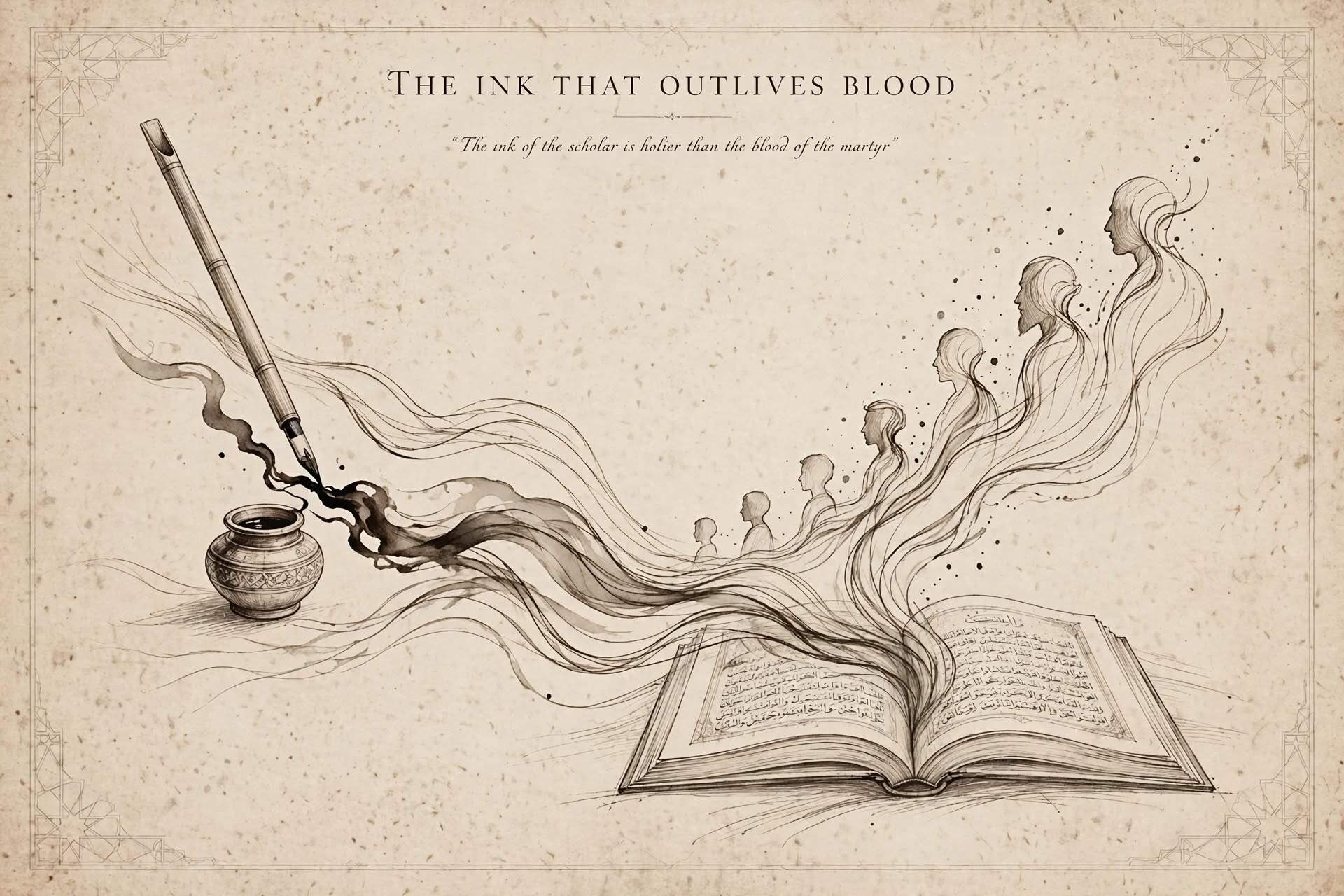
“The ink of the scholar is holier than the blood of the martyr.”
When we speak about sacrifice in Islam, our hearts are naturally drawn to the image of the martyr. There is something deeply powerful about a person who gives their life for truth. It is immediate, visible, and unforgettable.
But Islam asks us to think beyond the moment.
Look at the world today. The ideas that shape societies, the beliefs that guide people, and the movements that inspire change are not built in a single instant of sacrifice; they are built slowly, through words, teaching, and understanding. Through ink.
One of the clearest examples of this in our time is Sayed Ali Khamenei. Before being known as a political leader, he was a scholar, someone formed by years of study, reflection, and writing. His influence has not come from a single act, but from decades of speeches, books, and intellectual work that continue to shape minds across generations.
This is where the famous narration attributed to the Prophet Muhammad (peace be upon him and his family) begins to unfold in meaning: the ink of the scholar is holier than the blood of the martyr.
At first, this feels difficult to accept. How can ink something so quiet and unseen—be greater than blood, which represents the ultimate sacrifice?
But this statement is not diminishing the martyr. It is redefining how we understand impact.
A martyr sacrifices once.?
A scholar sacrifices every day.
A martyr’s blood shakes the world in a moment.?
A scholar’s ink reshapes the world over time.
And more importantly, it is often the scholar who teaches people what is worth sacrificing for in the first place.
History itself proves this.
Take the example of Ali ibn Husayn Zayn al-Abidin. After the tragedy of Karbala, he did not lead an army. He did not fight a visible battle. Instead, he rebuilt a broken Ummah through Dua (supplication), knowledge, and writing. His legacy lives on through works like Sahifa Sajjadiyya, a collection of supplications that continues to guide hearts centuries later.
His ink preserved the message of Karbala.
Without scholars like him, the sacrifice of the martyrs could have been lost, misunderstood, or even erased.
The same pattern continues in our time.
When we look at figures like Late Shaheed Ali Khamenei, we see that their influence is not limited to a moment of struggle. Their writings, teachings, and intellectual contributions build a framework through which entire communities understand justice, resistance, and faith. Books, lectures, and ideas travel far beyond borders and long after a lifetime ends.
This is the quiet strength of scholarship.
Ink does not shout, but it stays.?
Ink does not bleed, but it spreads.?
Ink does not end, but it continues.
And perhaps this is why it is described as “holier.” Not because it replaces sacrifice, but because it preserves it, explains it, and ensures that it is never forgotten.
In reality, the martyr and the scholar are not in opposition.
They are part of the same mission.
The martyr protects the truth in its most critical moment.?
The scholar protects the truth for every moment after that.
But without the scholar, the meaning of sacrifice can fade. Without guidance, even the greatest acts can be misunderstood. It is the pen that gives direction to emotion, clarity to struggle, and purpose to sacrifice.
So when we reflect on this narration, we are not being asked to choose between blood and ink.
We are being asked to recognise which one ensures that truth survives.
And in a world overflowing with noise, confusion, and misinformation, the need for scholars, for people of knowledge, depth, and sincerity, has never been greater.
Because in the end, blood may inspire a generation.
But ink builds generations.
Recent posts
- True self-development
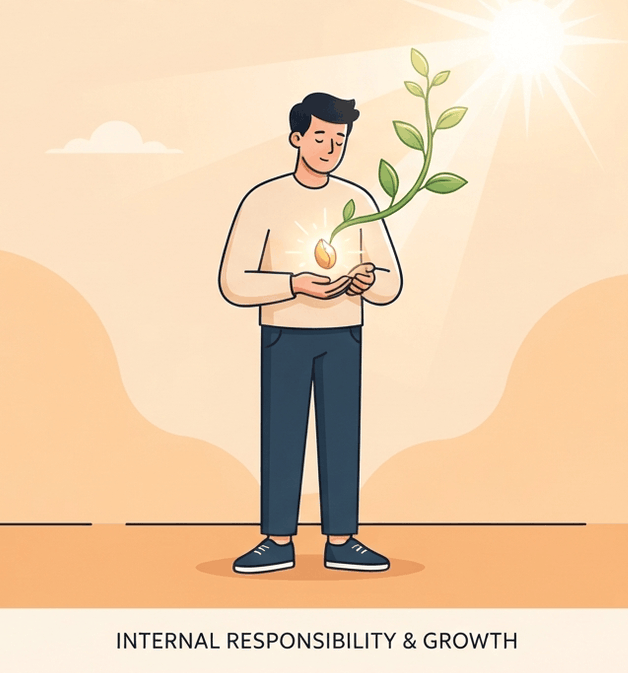 True self-development by Asgar Jafferali Dhanji While physical growth is easy to see, your mind, character, and professional capability evolve in ways that are much harder to gauge. If you look back five years, you are likely not the same person you were then. You are constantly evolving, but reaching the next level of your personal development requires conscious, deliberate action.
 - Adl
 Adl by Sheikh Fattah The concept of justice (‘Adl) occupies a foundational position in Islamic theology and ethics, serving as a lens through which the relationship between the Creator and creation is understood. In his insightful essay, “Adl – Justice and Decree,” originally published in the spring 1984 issue of the journal Nuradeen, Sheikh Fattah provides a concise yet profound exploration of this multi-faceted principle. Drawing extensively from the Holy Quran and the narrative traditions (ahadith) of the Ahlul Bayt – specifically Imam Ali and Imam Ja’far as-Sadiq—the author dismantles the complexities surrounding divine decree, free will, individual morality, and structural social justice. The text functions not merely as an academic exposition of theological doctrine, but as an ethical manifesto that bridges metaphysical truths with practical human responsibility.
 - Eternal Life
 Eternal Life by Ayatullah Murtadha Mutahhari Ayatullah Murtadha Mutahhari’s Eternal Life is a concise but profound exploration of one of Islam’s central beliefs: that human life does not end with death. Drawing on the Qur’an, hadith, Islamic philosophy, and rational argument, Motahhari presents the Hereafter not as a distant abstraction but as the destination that gives meaning to every thought, choice, and action in this world. The book is especially valuable for readers seeking a clear, reasoned introduction to Islamic teachings on death, the soul, barzakh, resurrection, and eternal life.