
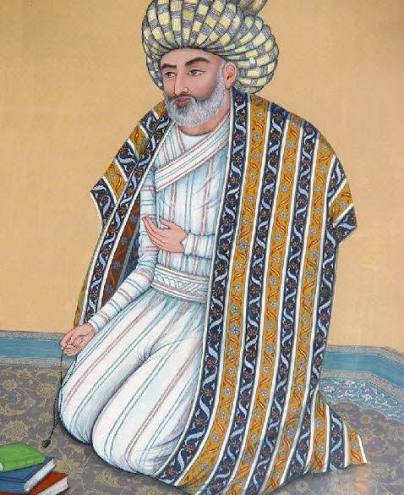
Muhammad Baqir ibn Muhammad al-Taqi al-Majlisi was a leading Iranian Twelver Shi’a theologian and aalim of the Safavid dynasty, whose teachings and activities became a formative influence on the subsequent development, practice, and organisation of Twelver Shi’ism. He has been described as “one of the most powerful and influential Shi’a Ulama of all time”, whose policies and actions helped redirect Twelver Shi’ism along the course it subsequently followed.
Majlesi strongly opposed the rationalisation of religion through philosophy, as well as Sufism and Sunnism, whose adherents he regarded as determined rivals. He succeeded in persuading the Shah to exclude Sunnis from Isfahan. He wrote in both Persian and Arabic, thereby reaching a substantially wider audience with his vigorous advocacy of Twelver Shi’ism. His principal work was Bihaar al-anwaar (“The Ocean of Lights”), a multivolume compilation of hadith. He also promoted devotion to the Imams and the elaboration of religious rituals, including devotion to the martyrs (shahid) and pilgrimage practices
Levels and rewards in Paradise
Chapter 23 of Volume 8 of Bihar Al-Anwaar – the encyclopaedic hadith compendium compiled by the Safavid-era scholar Allama Muhammad Baqir al-Majlisi – is entitled “The Paradise and Its Bounties, and Allah Sustaining Us and the Rest of the Believers, Its Houries, Its Castles, Its Joys and Its Cheerfulness.” Spanning roughly one hundred and eighty pages (pp. 106–285), it sits in the volume between the harrowing chapter on the Bridge over Hell and the chapter on the Fire itself, and it functions as a deliberate counterweight: where the preceding chapters describe terror, this one unfolds an almost luxuriant catalogue of delight. Reading it straight through is a peculiar experience – less a sustained argument than a long, liturgical inventory of a world the believer is invited to imagine as already in existence. This review summarises the chapter’s main themes and offers a few observations on its literary and theological texture.
The Architecture of Paradise: Levels and Doors
The chapter opens, in customary Majlisi fashion, with a dense run of Qur´anic verses – passages from Suras Al-Baqara, Aal-e-Imran, Al-Nisaa, Maryam, Al-Rahman, Al-Waqi’a, Dahr, and many others – establishing that Paradise is the Qur´an’s own recurring promise before the hadith material begins.
The Prophetic traditions then set out its general architecture. Paradise has eight doors, each said to be the width of a forty-year journey (H 32, p. 151). On each door is an inscription, and one of the chapter’s most striking passages records the Prophet’s account of being led by Jibraeel past all eight, reading what is written on each (H 67, pp. 170–173). Every door begins with the same formula: “There is no god except Allah, Muhammad is the Messenger of Allah, and Ali is the Guardian of Allah.” Beneath that header, each door lists four virtues – contentment and the company of the good on the first; compassion for orphans and widows on the second; scarcity of speech, sleep, walking, and food on the third; and so on through honouring guests, parents, and neighbours, building mosques, consoling the sick, and giving charity.
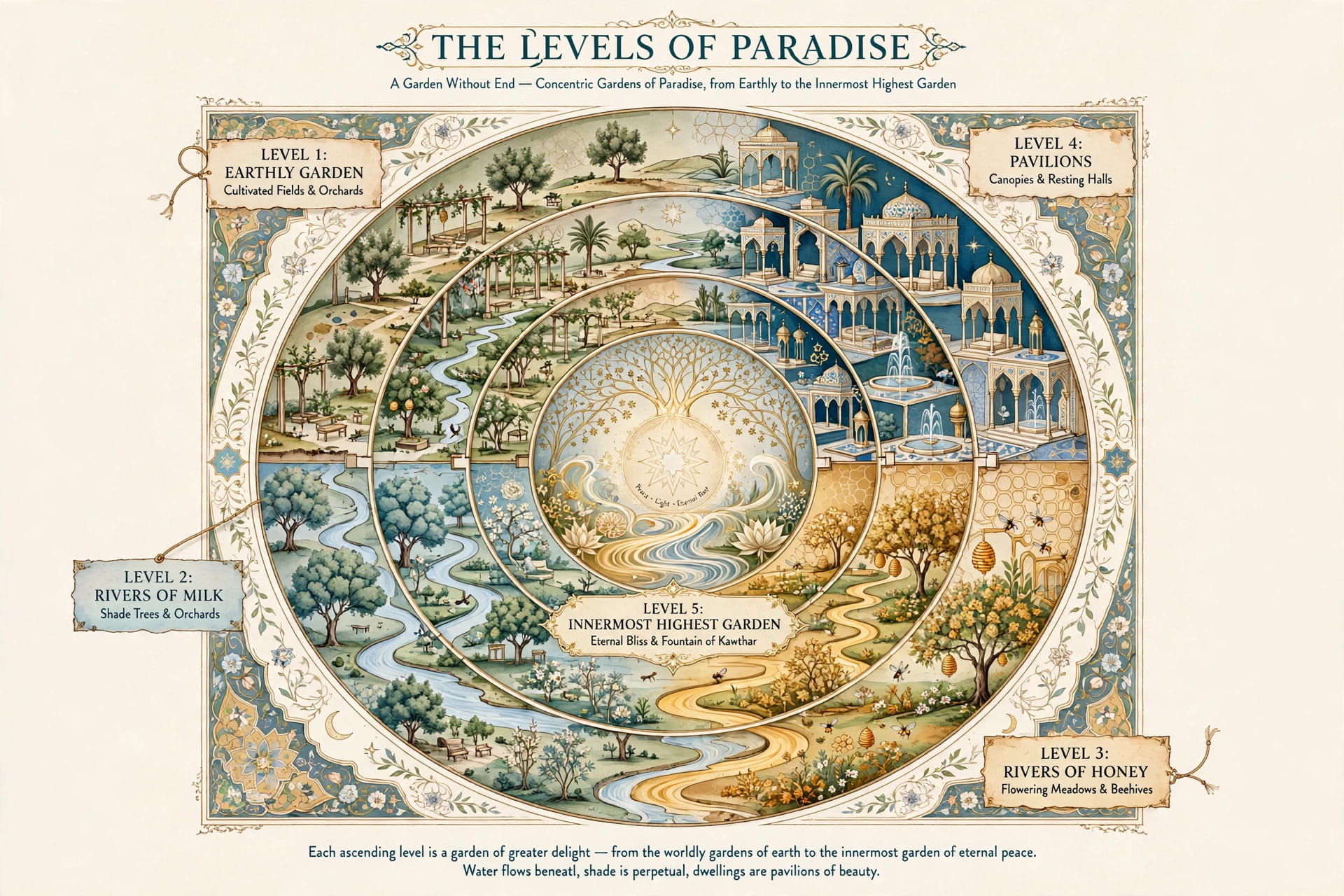
Within these doors lies a layered geography. Abu Ja’far (the fifth Imam) names the four Gardens mentioned in the Book as the Garden of Eden, the Garden of al-Firdows, the Garden of Naeem, and the Garden of al-Ma’wa, with Eden at the centre and the others surrounding it (H 92, p. 188).
The chapter is consistently interested in levels – darajaat – and ties them to specific acts of devotion. A tradition on the authority of the Prophet promises seventy levels in al-Firdows for one who prays the dawn prayer in congregation and remains in remembrance until sunrise, with the distance between any two levels being like the galloping of a strong racehorse for seven years; the midday prayer in congregation earns fifty levels in the Gardens of Eden (H 112, p. 175). Elsewhere the levels of Paradise are said to correspond to the verses of the Quran, so that the reciter ascends degree by degree (H 39, p. 154).
Trees, Castles, and the Tree of Tuba
If the chapter has a single organising symbol, it is the Tree of Tuba, returned to again and again across nearly 30 traditions. Tuba is described as a vast tree whose roots lie in the house of the Prophet – and, in a parallel strand, in the house of Imam Ali bin Abi Talib (H 2, p. 132; H 9, p. 135; H 64, p. 168). Its single leaves, the Prophet reports, could shade the whole world; a fast rider could travel in its shadow for a hundred years without emerging, and a crow flying from its base would die of old age before reaching its crown. Allah Himself is said to have planted it (H 63, p. 168). On it grow garments of silk and brocade, saddled horses with wings that do not foul the ground, and fruits of every colour, each branch stooping into the dwelling of every believer so that he may pick what he wishes without rising from his seat (H 49, p. 160; H 91, p. 185).
Around the tree are clustered the castles of Paradise. The Garden of Eden, the chapter tells us, is a single castle of pearl, without seam or crack, with a million doors of emerald and ruby, each door twelve miles wide (H 92, p. 188). The believer’s own chamber has a thousand doors, each attended by its own angel; within are couches raised one above another, filled with musk, ambergris, and camphor, and he is crowned and clothed in seventy garments woven with gold, silver, pearls, and red rubies (H 29, pp. 147–151).
Houries and Spouses
The chapter devotes considerable space to the Houris (al-hur al-’ayn), the maidens of Paradise. Their origin is given in two main versions: that they are created from saffron and soil that does not perish (H 14, p. 139), and that they are created from the essence of Paradise itself (H 11, p. 137). Their beauty is such that the marrow of the leg is visible through seventy garments, and yet each is described as modest of gaze. A tradition on the authority of Abu ‘Abdullah reports that the believer will marry eight hundred virgins, four thousand previously married women, and two spouses from the Houris (H 11, p. 137). They remain virgins after every union, because, the Imam explains, they were created from what is pure and have no menstruation, defect, or impurity (H 48, p. 159).
What gives the passage its unexpected tenderness, however, is that the Houris are granted speech. When asked what they will say, the Imam quotes them: “We are the eternal, so we will not be dying; we are the bountiful, and we do not despair; we are the stayers, and we will not be departing; we are the agreeable, and we do not get angry. Beatitude is for the one who is created for us, and beatitude is for one whom we have been created for” (H 11, p. 137). The effect is to soften what could otherwise be a merely sensual catalogue into something closer to a lyric refrain.
Rivers and Drinks
The chapter’s hydrology is no less elaborate. Paradise is watered by four classes of river – of water that does not stagnate, of milk whose taste does not change, of wine pleasant for drinkers, and of clear honey (Quran 47:15, expounded at H 49, p. 161). The chapter also identifies four rivers of this world as flowing from Paradise: the Euphrates as water, the Nile as honey, the Sayhan as wine, and the Jayhan as milk (H 30, p. 152). The greatest of all the rivers is al-Kausar, given to the Prophet in compensation for the loss of his son Ibrahim (H 45, p. 157); its width is said to equal 500 years of travel, and its waves are said to sing, glorify, and chant as the people of this world chant in song (H 71, p. 174). Two further springs – Salsabeel and Tasneem – supply the noblest of drinks: Tasneem is drunk pure by Muhammad and his progeny, the chapter tells us, and mixed for the rest of the inhabitants of Paradise (H 86, p. 181).
The Ahl al-Bayt as the Axis of Paradise
What finally holds the chapter together, across its many traditions, is the consistent identification of Paradise with the household of the Prophet. The chapter opens with the declaration that Paradise is forbidden to the Prophets themselves until Muhammad enters it, and forbidden to every community until the Shias of the Ahl al-Bayt enter it (H 65, p. 169). One tradition reports that Paradise has 71 doors, of which seventy are reserved for the Shias and family of Ali, and only one for the rest of humanity (H 55, p. 163). The Prophet is made to say that his house and the house of Ali are one, his level and the level of Ali are one, his veil and the veil of Ali are one (H 80, p. 178). The Tree of Tuba, planted in Ali’s courtyard, is given as the dower of his daughter Fatima (H 61, p. 168); Fatima herself is called a “human Hourie,” a fragment of Paradise carried in the Prophet’s ribs from the night of the Ascension and bestowed upon his household (H 6, p. 134; H 89, p. 183).
The effect of these traditions is to make the wilayah – the loving allegiance to Ali and his descendants – the very key that opens the gates. The believer who holds to it is ushered in without pause at the reckoning; the angels themselves are sent to pluck the deficient among the Shias from the plains of gathering “like the hawk snatches its prey” (H 45, p. 63 of the preceding chapter, recapitulated here). Paradise, in other words, is not merely a place of reward but a household, and entry into it is imagined as entry into the household of the Prophet.
A Concluding Note
For an average reader, the chapter can be a great deal. Its repetitions, its cascading numbers – 70,000 of this, a 100,000 of that – and its sheer material lavishness can feel exhausting. Yet there is a logic to the excess. The chapter is not really trying to describe a place; it is trying to stretch the imagination until it breaks, to push the reader past any calculus of merit and into the recognition that the Hereafter exists on a scale that beggars the world. The recurring refrain of the Houries – “we are the eternal, so we will not be dying” – is the chapter’s real theme, and the gold and pearls and rubies are, in the end, only the language in which that theme is sung.
Read as a book chapter, then, Chapter 23 is best approached not as a doctrinal manual but as a piece of devotional literature. Its interest is less in systematic theology than in the cultivation of longing. For the reader patient enough to move slowly through its nearly two hundred pages, it offers a sustained exercise in just that.
Recent posts
- A Garden Without End
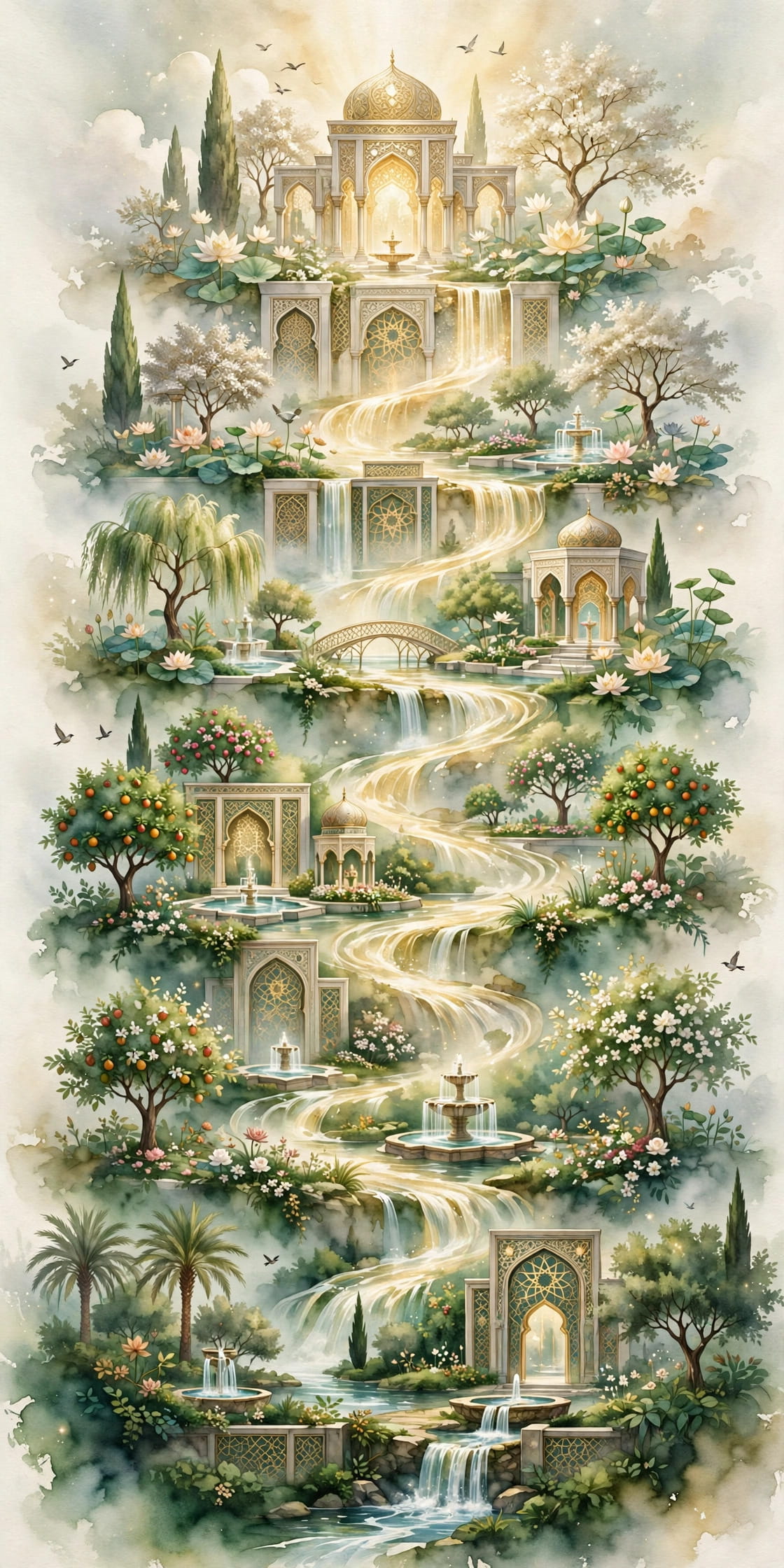 A Garden Without End Review of Chapter 23 of Bihar Al-Anwaar, Volume 8 Author – The Allama Muhammad Baqir Al Majlisi Chapter 23 of Volume 8 of Bihar Al-Anwaar – the encyclopaedic hadith compendium compiled by the Safavid-era scholar Allama Muhammad Baqir al-Majlisi – is entitled “The Paradise and Its Bounties, and Allah Sustaining Us and the Rest of the Believers, Its Houries, Its Castles, Its Joys and Its Cheerfulness.” Spanning roughly one hundred and eighty pages (pp. 106–285), it sits in the volume between the harrowing chapter on the Bridge over Hell and the chapter on the Fire itself, and it functions as a deliberate counterweight: where the preceding chapters describe terror, this one unfolds an almost luxuriant catalogue of delight. Reading it straight through is a peculiar experience – less a sustained argument than a long, liturgical inventory of a world the believer is invited to imagine as already in existence. This review summarises the chapter’s main themes and offers a few observations on its literary and theological texture.
- Marhum (Maalim) Ibrahim Husseinali Nathoo
 Marhum (Maalim) Ibrahim Husseinali Nathoo 1942-2024 The Khoja Shia Ithna-Asheri Jamaat of Dar es Salaam mourns the loss of Ibrahim Husseinali Nathoo, who passed away on 23rd October 2024. Ibrahim bhai was a true pillar of our community, a dedicated teacher, and an inspiring example of humility, commitment, and selfless service. Born on 23rd November 1942 in Zanzibar, Ibrahim bhai devoted his life to the service of others. His journey of community service began early and spanned decades, touching countless lives. He served as a teacher and mentor at Husayni Madrasah, where he shaped the minds and souls of multiple generations, always with a kind smile and a humble spirit. His commitment went beyond teaching; he was a guardian, a guide, and a fatherly figure to all who passed through the Madrasah doors.
- The Day of Judgement
 The Day of Judgement by Mohamedarif Suleman Every believer returns to the same question at some point: when this life ends, what remains of us? The Shia Imami tradition answers with clarity. On the Day of Judgement (Yawm al-Qiyaamah), human beings will be raised as whole persons, body and soul reunited, to stand before their Creator. This belief is known in theology as ma’aad jismaani, bodily resurrection, and it is one of the pillars of Islamic faith, listed among the usool al-din alongside tawhid, prophethood and divine justice.


