
Work Life Balance
 The writer, Dr Hasnain Gulamali Walji (Texas, USA), is the Head of the Khoja Heritage Project of The World Federation of KSIMC. A lifelong educator and historian, he has dedicated over three decades to documenting the rich, socio-religious journey of the Khoja Shia Ithna-Asheri community. His landmark documentary, The Khojas – A Journey of Faith, traces this evolution across 600 years. Over the past 30 years he had been collecting care Gujarati and Khoji history books housed at the Mulla Asghar Memorial Library in Toronto, which he co-founded with Raza-Aly Hiridjee.
Serving for almost half a century, he had been the former Secretary General, Vice President, and President of The World Federation. Professionally, he is a nutritionist and has also authored 26 books on naturopathic medicine, translated into several languages. As Executive Director of the United Global Initiative and a Trustee of the Jaffer Family Foundation, he leads the CodeGirls project, which empowers underprivileged girls to pursue technology careers. He has also been instrumental in facilitating the ‘Ashura at Harvard’ study track at Harvard Divinity School, promoting academic discourse on Shi’ism through the fully funded the JafferFamily Foundation.
Let’s be honest – Schrödinger’s cat has it easy.
It doesn’t answer emails.
It doesn’t sit through “quick” meetings that last an hour.
It doesn’t need to post “Grateful. #MondayMotivation” to remind itself it’s still breathing.
It just sits quietly in a box – alive, dead, or both – and no one asks it for an update.
The Original Experiment – Once Upon a Time in a Lab
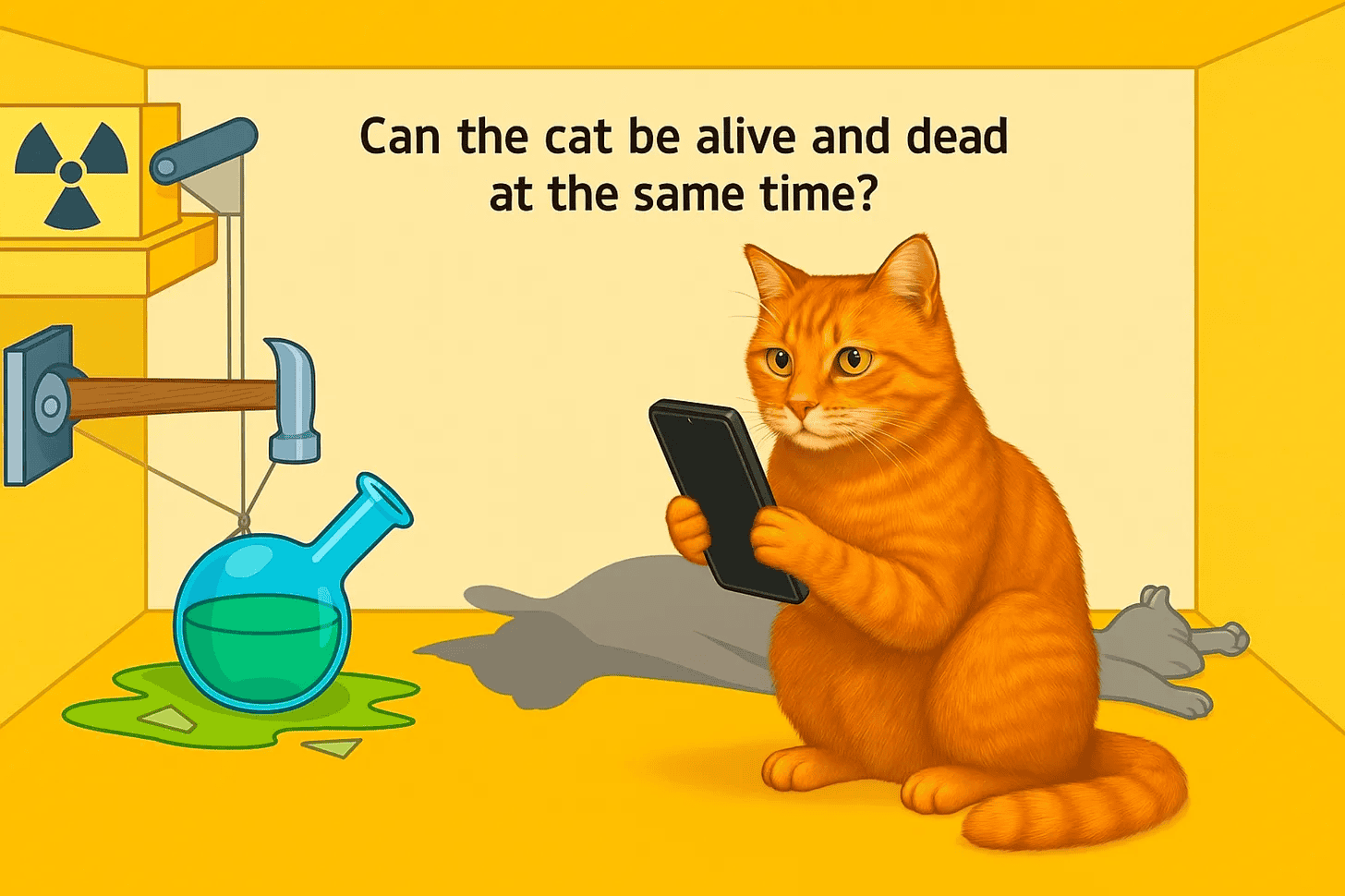
In 1935, physicist Erwin Schrödinger had an idea that was either genius or the first recorded case of a mental breakdown caused by math. He imagined a cat locked in a sealed steel box – along with a radioactive atom, a Geiger counter, a hammer, and a vial of poison.
If the atom decayed, the Geiger counter clicked, the hammer broke the vial, the poison was released, and the cat died. If the atom didn’t decay, the cat lived. So, statistically, there was a 50/50 chance.
But according to quantum theory, until you opened the box, the atom was both decayed and not decayed, which meant the cat was both alive and dead. Schrödinger wasn’t torturing cats; he was mocking how absurd quantum theory sounds when applied to ordinary life. Little did he know – 80 years later, we’d live it daily, voluntarily, and on Instagram.
We’ve become the cats. The box has evolved. It’s now a smartphone. Inside: our curated selves – luminous, filtered, and fundamentally confused.
We post something “authentic.”
Until someone likes it, we exist in a quantum state – both brilliant and irrelevant.
One heart: alive.
No hearts: existential crisis.
Even Mulla Nasruddin predicted this centuries ago.
“I don’t care what people think of me,” he said, “as long as they think of me.”
He invented Instagram before Zuckerberg could spell algorithm.
Schrödinger’s Employee
Working from home? You’re a quantum professional.
Camera off, mic muted – you exist in two parallel universes: one productive, one horizontal.
Until your boss says, “Any thoughts?”
The wave collapses.
“Yes, I agree,” you reply, with absolutely no idea what you’ve agreed to.
Nasruddin would’ve called that potential energy.
Schrödinger’s Politician
Of course, the cat isn’t the only one living in two realities.
Take a certain politician from New York.
Publicly, he’s a Democrat – quotes FDR, wears empathy on his lapel.
Privately, he dreams in Republican red and billionaire lullabies. Unable to reconcile the two, he declares himself Independent – not from ideology, but opportunity. He’s not left-wing or right-wing.
He’s a quantum-wing – fluttering wherever the optics look good.
One foot in liberal coffee shops, one foot in conservative fundraisers. One conscience – permanently undecided. He’s Schrödinger’s cat in a suit – politically alive, ethically deceased. And yet, he wonders why he doesn’t get re-elected.
Schrödinger’s Citizen
But let’s not get smug. We’re all in some duality.
Schrödinger’s Faith
I meditate. Sometimes sincerely. Sometimes, because my smartwatch told me to. Faith today has push notifications. I believe in destiny, but I also track my steps.
Nasruddin had it right:
“Trust in Allah – but still tie your camel.”
Schrödinger’s Identity
Online, I’m articulate, inspired, and freshly moisturised. Offline, I look like an unclaimed suitcase.
Every post I share collapses into two realities: Half the world thinks I’m thriving. The other half scrolls past politely. And I pretend not to check.
Nasruddin once said,
“I’m not pretending to be someone I’m not – I’m pretending to be who people think I am.”
That’s not philosophy. That’s LinkedIn.
Schrödinger’s Truth
Schrödinger asked, “Does observation create reality?”
Today, we answer, “Only if it gets engagement.”
The universe used to wait for us to look. Now it waits for us to scroll. Facts no longer trend. Feelings do.
The Real Experiment – Inside Us
Here’s the twist. The cat isn’t the problem. We are.
We live in contradiction – faith on our lips, doubt in our hearts. Love in our captions, ego in our actions. Awake and asleep – at the same time. That’s our superposition.
But we weren’t designed for duality. Our original operating system – fitrah – runs on coherence. It’s built for truth, not performance. When we betray that design, our souls start to glitch. We buffer. We lag. We ache. That ache isn’t random – it’s your system warning: You’re living against your settings.
Schrödinger’s cat waited in silence.
We sit in our digital boxes – swiping, scrolling, switching identities – and call it living.
But peace doesn’t come from observation. It comes from alignment. When we return to fitrah, the contradictions collapse. The noise fades. The heart finally rests – alive, aware, and no longer confused.
The Final Meow
Maybe Schrödinger’s cat wasn’t about quantum theory. Maybe it was a prophecy – about a world where we live in boxes of our own making, half alive, half online, waiting for a notification to prove we exist.
So here’s my conclusion after years of research and reheated leftovers: The cat is fine. It’s me who’s a scientific tragedy.
Maybe Schrödinger’s cat wasn’t a thought experiment at all. Maybe it was prophecy. About a generation that would live half alive and half online, half spiritual and half cynical, half certain and half pretending.
The cat wasn’t the paradox. We are.
As Mulla Nasruddin would grin and say,
“In this life, my friend, we are all experiments. Some just meow louder than others.”
More from this Writer
Latest posts
- True self-development
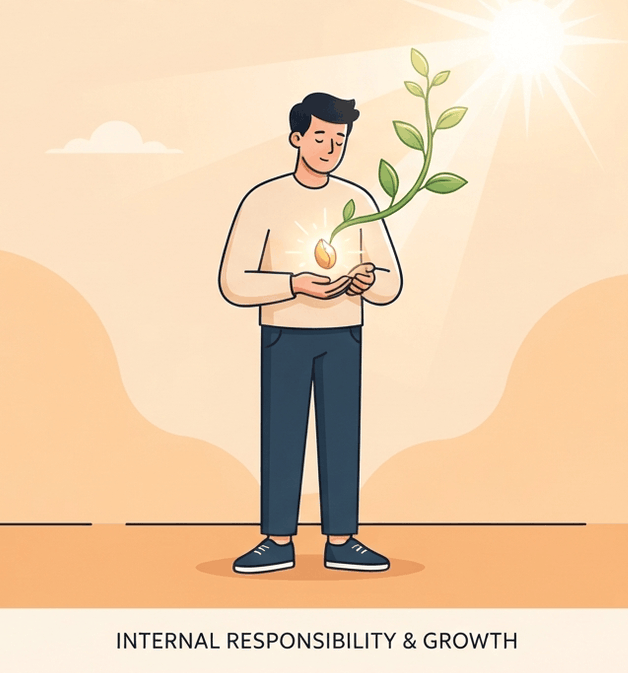 True self-development by Asgar Jafferali Dhanji While physical growth is easy to see, your mind, character, and professional capability evolve in ways that are much harder to gauge. If you look back five years, you are likely not the same person you were then. You are constantly evolving, but reaching the next level of your personal development requires conscious, deliberate action.
 - Adl
 Adl by Sheikh Fattah The concept of justice (‘Adl) occupies a foundational position in Islamic theology and ethics, serving as a lens through which the relationship between the Creator and creation is understood. In his insightful essay, “Adl – Justice and Decree,” originally published in the spring 1984 issue of the journal Nuradeen, Sheikh Fattah provides a concise yet profound exploration of this multi-faceted principle. Drawing extensively from the Holy Quran and the narrative traditions (ahadith) of the Ahlul Bayt – specifically Imam Ali and Imam Ja’far as-Sadiq—the author dismantles the complexities surrounding divine decree, free will, individual morality, and structural social justice. The text functions not merely as an academic exposition of theological doctrine, but as an ethical manifesto that bridges metaphysical truths with practical human responsibility.
 - Eternal Life
 Eternal Life by Ayatullah Murtadha Mutahhari Ayatullah Murtadha Mutahhari’s Eternal Life is a concise but profound exploration of one of Islam’s central beliefs: that human life does not end with death. Drawing on the Qur’an, hadith, Islamic philosophy, and rational argument, Motahhari presents the Hereafter not as a distant abstraction but as the destination that gives meaning to every thought, choice, and action in this world. The book is especially valuable for readers seeking a clear, reasoned introduction to Islamic teachings on death, the soul, barzakh, resurrection, and eternal life.
Writers Panel | A Simple Thought | Obituaries | Ziarat Ashura | Islamic Calendar | Facebook | Instagram


Leave a Reply
You must be logged in to post a comment.