


The author is the Head of the Khoja Heritage Project of The World Federation of KSIMC. A lifelong educator and historian, he has dedicated over three decades to documenting the rich, socio-religious journey of the Khoja Shia Ithna-Asheri community. His landmark documentary, The Khojas – A Journey of Faith, traces this evolution across 600 years. Over the past 30 years, he has been collecting rare Gujarati and Khoja history books housed at the Mulla Asghar Memorial Library in Toronto, which he co-founded with Raza-Aly Hiridjee.
Serving for almost half a century, he had been the former Secretary General, Vice President, and President of The World Federation. Professionally, he is a nutritionist and has also authored 26 books on naturopathic medicine, translated into several languages. As Executive Director of the United Global Initiative and a Trustee of the Jaffer Family Foundation, he leads the CodeGirls project, which empowers underprivileged girls to pursue careers in technology. He has also been instrumental in facilitating the ‘Ashura at Harvard’ study track at Harvard Divinity School, promoting academic discourse on Shi’ism through the fully funded Jaffer Family Foundation.
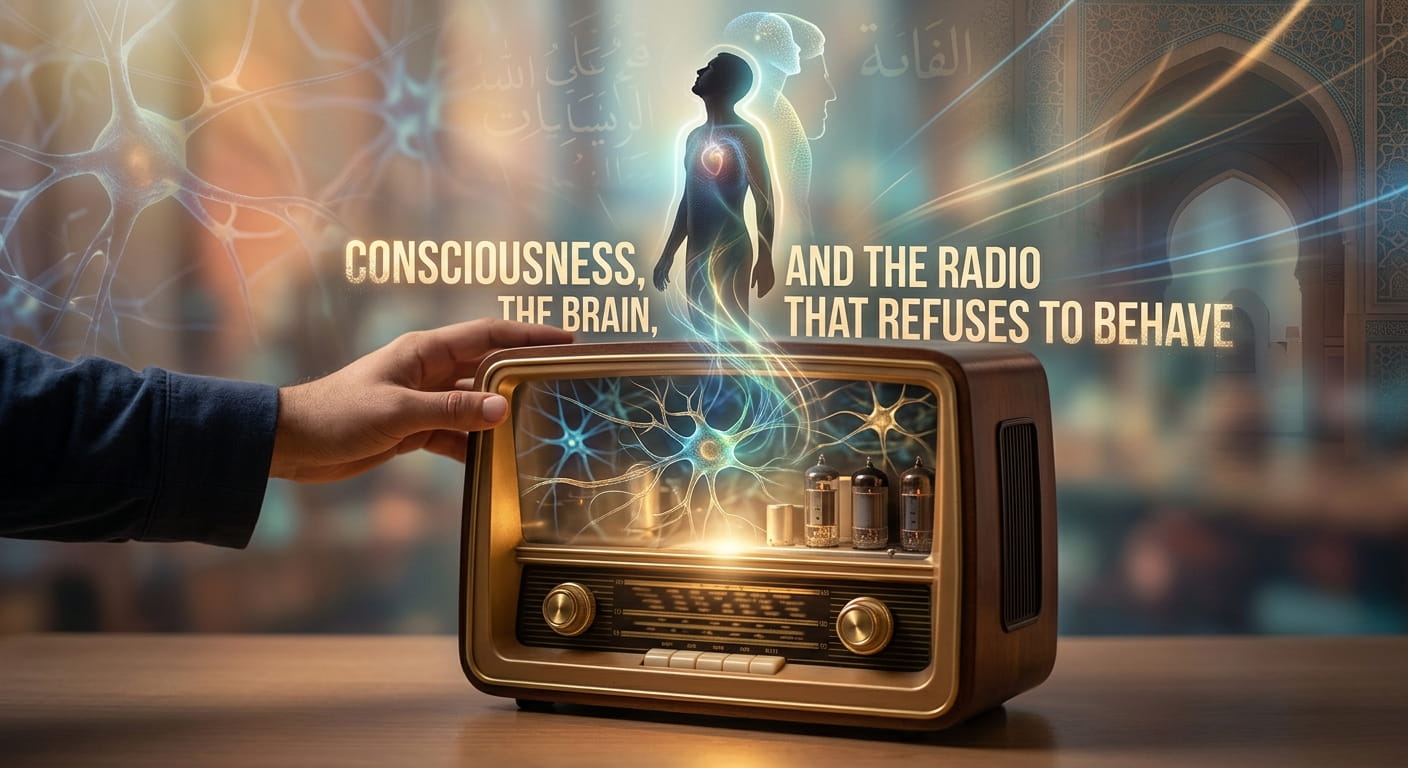
We have never known more about the brain. And perhaps never been less certain what the human being is for.
Nassim Haramein once joked that looking for consciousness inside the brain is like opening a radio and searching for the announcer.
It is a sharp line.
It is also irritating because it makes sense.
Modern neuroscience has done extraordinary work. It maps the brain. It studies memory, trauma, emotion, language, decision-making, perception, and the regrettable human impulse to reply to WhatsApp arguments after midnight.
This is impressive.It is also not the whole story.
A radio has wires, circuits, knobs, speakers, and a casing. Damage the circuitry and the sound becomes distorted. Smash the speaker and the music disappears. But that does not mean the announcer lives inside the box, hunched beside a tiny microphone, negotiating rent.
Likewise, the brain is essential. It is not optional equipment. But Islamic thought has long resisted the idea that the human being is merely a skull full of electricity wearing shoes.
The brain is indispensable, but it may not be ultimate. Islamic thought does not deny the circuitry. It asks what the circuitry is serving. It shifts the question from where consciousness happens to what consciousness is for.
That is a different question.
And a far more dangerous one.
The point is not to deny neuroscience. That would be lazy, and laziness dressed as spirituality is still laziness. The point is to ask whether neuroscience alone can explain meaning, moral responsibility, longing, repentance, beauty, guilt, prayer, and the strange human experience of being addressed by God.
Islamic thought gives us a map of the human interior. It is not a rival brain scan. It is a moral and spiritual architecture of the human being.
The Qur’an speaks of the qalb, the heart. It speaks of the nafs, the self. It speaks of the ?aql, the intellect. It speaks of the r??, the spirit. Later Muslim thinkers, poets, and philosophers, especially Iqbal, speak of khudi, the awakened self.
Body, brain, heart, self, intellect, spirit, and moral will: a whole inner parliament.
No wonder we are exhausted.
The Brain Processes. The Human Being Perceives.
The Qur’an says:
“It is not the eyes that are blind, but the hearts within the chests that are blind.”
Qur’an 22:46
That verse is devastatingly precise.
It does not deny the eye. It does not deny the body. It does not deny sensory perception.
It simply says physical seeing is not the same as true seeing.
A person may have perfect eyesight and still fail to recognise truth. He may read the facts, watch the suffering, hear the cry, study the evidence, and still say, “Let us wait for more information.”
Humanity’s favourite hobby, apparently.
The Qur’an points to a deeper faculty: the qalb.
The qalb is not merely the emotional heart of greeting cards, sentimental speeches, and wedding poetry that should have been quietly stopped by a responsible adult. It is the inner centre of recognition. It is where truth is received, where moral responsibility awakens, where divine guidance becomes personal.
This is why the brain may process data, but the qalb understands meaning.
The brain sees an orphan.
The qalb asks, “What does this demand of me?”
The brain hears a verse.
The qalb trembles.
The brain reads the news.
The qalb refuses to remain comfortable.
That is the difference.
A machine can register information. A human being is accountable for it.
If the brain is the radio’s circuitry, the qalb is the receiver of meaning. The circuitry matters. Without it, the broadcast falters in this life. Injury, illness, trauma, dementia, depression, and anxiety all show how deeply our spiritual and mental lives pass through the body.
Islam is not asking us to ignore medicine.
Please, for the sake of civilisation and emergency rooms everywhere, do not replace clinical treatment with vague spiritual slogans, forwarded duas, and herbal optimism.
The body matters. The brain matters. Medicine matters. Therapy matters.
But Islamic thought asks whether the brain alone explains the full mystery of human consciousness. It asks whether awareness is only a chemical reaction, or whether the human being also receives meaning from a deeper source.
The tragedy is not that the signal is absent.
The tragedy is that the receiver is often busy streaming ego in high definition.
The Nafs: Static With Excellent Marketing
Then there is the nafs.
The nafs is the self. But not the calm, enlightened self posing beside tea on Instagram. The nafs is the self that wants, fears, envies, boasts, excuses, and occasionally writes long messages beginning with “With all due respect,” when there is, in fact, no respect left.
Islamic psychology describes different states of the nafs.
There is al-nafs al-amm?rah, the commanding self. This is the self that pushes us toward appetite, pride, anger, greed, and self-justification.
It says:
Eat more.
Buy more.
Win the argument.
Protect the image.
Crush the rival.
Call it principle.
Then there is al-nafs al-laww?mah, the reproaching self. This is conscience. It is the inner voice that arrives after the damage and says, “Really? That was your best?”
Annoying, yes.
But useful.
Like a moral smoke alarm.
Then there is al-nafs al-mu?ma?innah, the tranquil self. The Qur’an addresses it with astonishing tenderness:
“O tranquil soul, return to your Lord, pleased and pleasing.”
Qur’an 89:27–28
That is the goal.
Not merely to think. Not merely to function. Not merely to survive the calendar like a well-dressed animal with passwords.
The goal is inner peace before God.
The nafs is the static on the radio. It interrupts the signal. It turns divine guidance into background noise and makes our desires sound urgent, reasonable, and tragically misunderstood.
The nafs is not stupid.
It is a gifted lawyer.
It can defend anything.
This is why consciousness cannot be reduced to awareness alone. Awareness can be hijacked. Intelligence can be recruited into self-deception. A person may know exactly what is right and still build a polished argument for doing the opposite.
The human problem is not merely ignorance.
Often, it is evasion.
The ?Aql: Intelligence With Moral Direction
Islam also speaks of ?aql, the intellect.
In modern life, intelligence often means speed. Who can answer faster? Who can analyse better? Who can win the debate? Who can make the algorithm bow like a frightened intern?
But the Qur’anic idea of intellect is not mere cleverness. It is moral intelligence. The ability to recognise truth and submit to it.
That last part is inconvenient.
Naturally.
The Qur’an repeatedly asks: Will you not think? Will you not reflect? Will you not understand?
These are not invitations to become smug. They are calls to wake up.
In Islamic thought, the ?aql is not just a calculator. It is a faculty of discernment. It helps us distinguish truth from illusion, guidance from ego, wisdom from noise.
A person can be brilliant and still be foolish.
This is one of history’s most consistent findings.
Empires have been built by clever fools. Markets have been crashed by clever fools. Families have been wounded by clever fools. Social media, meanwhile, appears to be their annual convention.
The ?aql is meant to tune the human being toward reality. It should discipline the nafs and awaken the qalb.
The problem is that many of us use intellect not to find truth, but to protect our favourite lies.
A tragedy, yes.
But at least it comes with footnotes.
The R?? and N?r: Mystery and Light
Then comes the r??, the spirit.
The Qur’an says:
“They ask you concerning the spirit. Say: the spirit is from the command of my Lord, and you have been given only a little knowledge.”
Qur’an 17:85
This is one of the great verses of intellectual humility.
It does not tell us to stop thinking. It tells us to stop pretending we have conquered the mystery.
The r?? reminds us that the human being is not self-created. We are not merely biological accidents wandering between breakfast and burial. We carry within us something sacred, something breathed, something that cannot be fully reduced to brain chemistry.
Islam does not deny matter.
It dignifies it.
The human being is clay and spirit. Dust and divine address. Hunger and prayer. Weakness and longing. A creature who can forget where he left his glasses while asking about eternity.
This is what makes us strange.
And beautiful.
And occasionally unbearable.
Recent posts
- True self-development
 True self-development by Asgar Jafferali Dhanji While physical growth is easy to see, your mind, character, and professional capability evolve in ways that are much harder to gauge. If you look back five years, you are likely not the same person you were then. You are constantly evolving, but reaching the next level of your personal development requires conscious, deliberate action.
 - Adl
 Adl by Sheikh Fattah The concept of justice (‘Adl) occupies a foundational position in Islamic theology and ethics, serving as a lens through which the relationship between the Creator and creation is understood. In his insightful essay, “Adl – Justice and Decree,” originally published in the spring 1984 issue of the journal Nuradeen, Sheikh Fattah provides a concise yet profound exploration of this multi-faceted principle. Drawing extensively from the Holy Quran and the narrative traditions (ahadith) of the Ahlul Bayt – specifically Imam Ali and Imam Ja’far as-Sadiq—the author dismantles the complexities surrounding divine decree, free will, individual morality, and structural social justice. The text functions not merely as an academic exposition of theological doctrine, but as an ethical manifesto that bridges metaphysical truths with practical human responsibility.
 - Eternal Life
 Eternal Life by Ayatullah Murtadha Mutahhari Ayatullah Murtadha Mutahhari’s Eternal Life is a concise but profound exploration of one of Islam’s central beliefs: that human life does not end with death. Drawing on the Qur’an, hadith, Islamic philosophy, and rational argument, Motahhari presents the Hereafter not as a distant abstraction but as the destination that gives meaning to every thought, choice, and action in this world. The book is especially valuable for readers seeking a clear, reasoned introduction to Islamic teachings on death, the soul, barzakh, resurrection, and eternal life.