

A medical doctor turned teacher. He pursued his medical degree in India and took the United States medical licensing exams in the USA. He also has a postgraduate diploma in education from the University of Dar es Salaam. He is the author of the book, “Learning How To Learn: Doing well in school, college and beyond”. He is passionate about education and teaching, with interests also in philosophy, science, theology and spirituality.

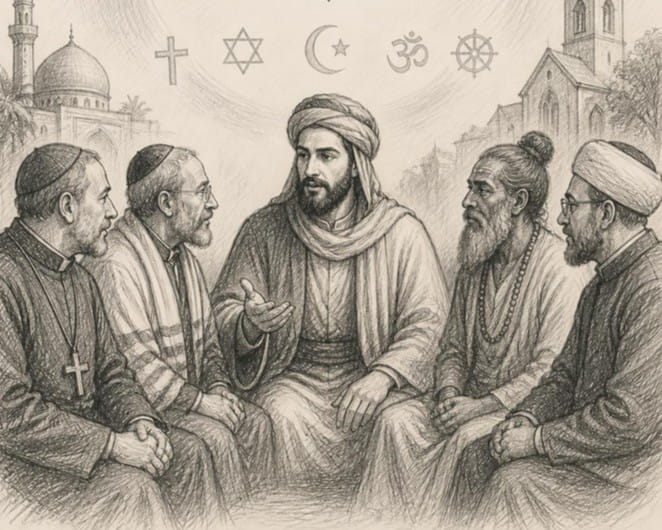
Exploring Imam Husayn’s timeless message of interfaith dialogue, religious freedom, human dignity and tolerance.
His universal approach to all human beings regardless of their faiths or lack thereof.
History records that as his enemies approached him and his family during the battle of Karbala, Al-Husayn addressed them as follows,
“If you do not believe in any religion and do not fear the Resurrection Day, then at least be free men in your worldly life, and return to your ancestry if you claim to be Arabs.” (Bihar al-Anwar, Vol. 45; Maqtal al-Khwarazmi, Vol. 2)
Husayn’s central message was one of individual and collective freedom, irrespective of one’s religious beliefs. In other words, he believed in freedom of choice, which resonates with the Quran:
“Let there be no compulsion in religion, for the truth stands out clearly from falsehood. So whoever renounces false gods and believes in Allah has certainly grasped the firmest, unfailing hand-hold. And Allah is All-Hearing, All-Knowing.” (Sura 2:256)
His protection of the non-Muslim minority communities (Dhimmi)
Al-Husayn continued to uphold the teachings of the Quran and of his grandfather and father in protecting the rights of the non-Muslim members of the society.
“The blind, the dumb, and the chronically ill are being neglected in the cities, and you have no mercy on them… You have compromised with the oppressors… and handed over the affairs of God to them.” (Tuhaf al-Uqul, Sermon of Mina)
Historical commentators tell us that the ‘the blind and chronically ill’ included both Muslim and non-Muslim subjects who relied on the public treasury for support. Thus, Imam Husayn made no distinction based on religious identity. This is consistent with what the Prophet did when he drafted the Medina Charter and granted religious freedom and protection to the Jews and Christians of Medina. This is consistent with Imam Ali when he talked of people being either our brothers in faith or our equals in humanity.
His emphasis on questioning one’s own assumptions
“A sign of a scholar is his self-criticism of his own words, and his familiarity with the various viewpoints of truth.“ (Bihar al-Anwar, Vol. 78)
This statement of Al- Husayn suffices to show that he did not believe in blind religious dogmatism but rather that one’s faith must be grounded in critical thinking and reasoning as well as being open to hearing different points of view from others. This is consistent with the Quran’s stance on questioning and critical thinking:
“ Certainly, in Yusuf and his brothers there are signs for the inquirers. “ (Sura 12:7)
The Arabic here says, “ayaatu li saa’ileen”, that is, in the story of Joseph and his brothers there are signs for those who ask questions.
His perception that all humans are equal
“People are equal like the teeth of a comb; a person becomes noble only through virtue, and honourable through piety.” (Tuhaf al-Uqul)
Nobility is attained through virtuous action and honour through righteousness. They have nothing to do with which “religious camp” one belongs to. This is consistent with the Quran as well:
“Surely those who believe, and those who are Jews, and the Christians, and the Sabians, whoever believes in Allah and the Last day and does good, they shall have their reward from their Lord, and there is no fear for them, nor shall they grieve. “ (Sura 2:62)
“ Surely those who believe and those who are Jews and the Sabians and the Christians whoever believes in Allah and the last day and does good — they shall have no fear nor shall they grieve. “ (Sura 5:69)
Imam Husayn has become a symbol for many things, including prioritising shared human values and principles as well as fostering religious tolerance. In a world that continues to be filled with religious fanaticism and intolerance as well as xenophobia, the words of Husayn can help remove the smog from our mental perceptions should we decide to pause and reflect on them.
The spiritual teacher and author Deepak Chopra once remarked that when someone points out the Moon for you, admire the Moon; don’t worship his finger. Imam Husayn has left for us a blazing trail of truth and wisdom. Let us try to apply some of his principles in our lives, even if poorly – instead of worshipping him. May Peace and Blessings be upon Husayn and his family and those who fell with them on the hallowed ground of Karbala.
Recent posts
- True self-development
 True self-development by Asgar Jafferali Dhanji While physical growth is easy to see, your mind, character, and professional capability evolve in ways that are much harder to gauge. If you look back five years, you are likely not the same person you were then. You are constantly evolving, but reaching the next level of your personal development requires conscious, deliberate action.
 - Adl
 Adl by Sheikh Fattah The concept of justice (‘Adl) occupies a foundational position in Islamic theology and ethics, serving as a lens through which the relationship between the Creator and creation is understood. In his insightful essay, “Adl – Justice and Decree,” originally published in the spring 1984 issue of the journal Nuradeen, Sheikh Fattah provides a concise yet profound exploration of this multi-faceted principle. Drawing extensively from the Holy Quran and the narrative traditions (ahadith) of the Ahlul Bayt – specifically Imam Ali and Imam Ja’far as-Sadiq—the author dismantles the complexities surrounding divine decree, free will, individual morality, and structural social justice. The text functions not merely as an academic exposition of theological doctrine, but as an ethical manifesto that bridges metaphysical truths with practical human responsibility.
 - Eternal Life
 Eternal Life by Ayatullah Murtadha Mutahhari Ayatullah Murtadha Mutahhari’s Eternal Life is a concise but profound exploration of one of Islam’s central beliefs: that human life does not end with death. Drawing on the Qur’an, hadith, Islamic philosophy, and rational argument, Motahhari presents the Hereafter not as a distant abstraction but as the destination that gives meaning to every thought, choice, and action in this world. The book is especially valuable for readers seeking a clear, reasoned introduction to Islamic teachings on death, the soul, barzakh, resurrection, and eternal life.


