
Applied Islamic Thought
 Mohamedarif Mohamed Suleman (Dar es Salaam, Tanzania) is a digital marketing specialist and an Educator-cum-Trainer. He has involved himself in community organisations and matters from a young age, and through his writings, continues to speak of social and cultural reform to this day. He is also the founding moderator of this forum.
Life, viewed through the Islamic lens, is a continuous act of seeking balance and justice – a dynamic path encapsulated by the term Mizan, or equilibrium. Yet, we frequently encounter consequential conflicts – deep-seated disagreements where the friction isn’t over facts, but over which deeply-held value should take precedence when an action is required. These conflicts, far from being mere intellectual sparring, shape our homes, communities, policies and societies, demanding a perspective-taking rooted in faith and empathy to achieve truly novel solutions.
The Myth of Neutral Ground
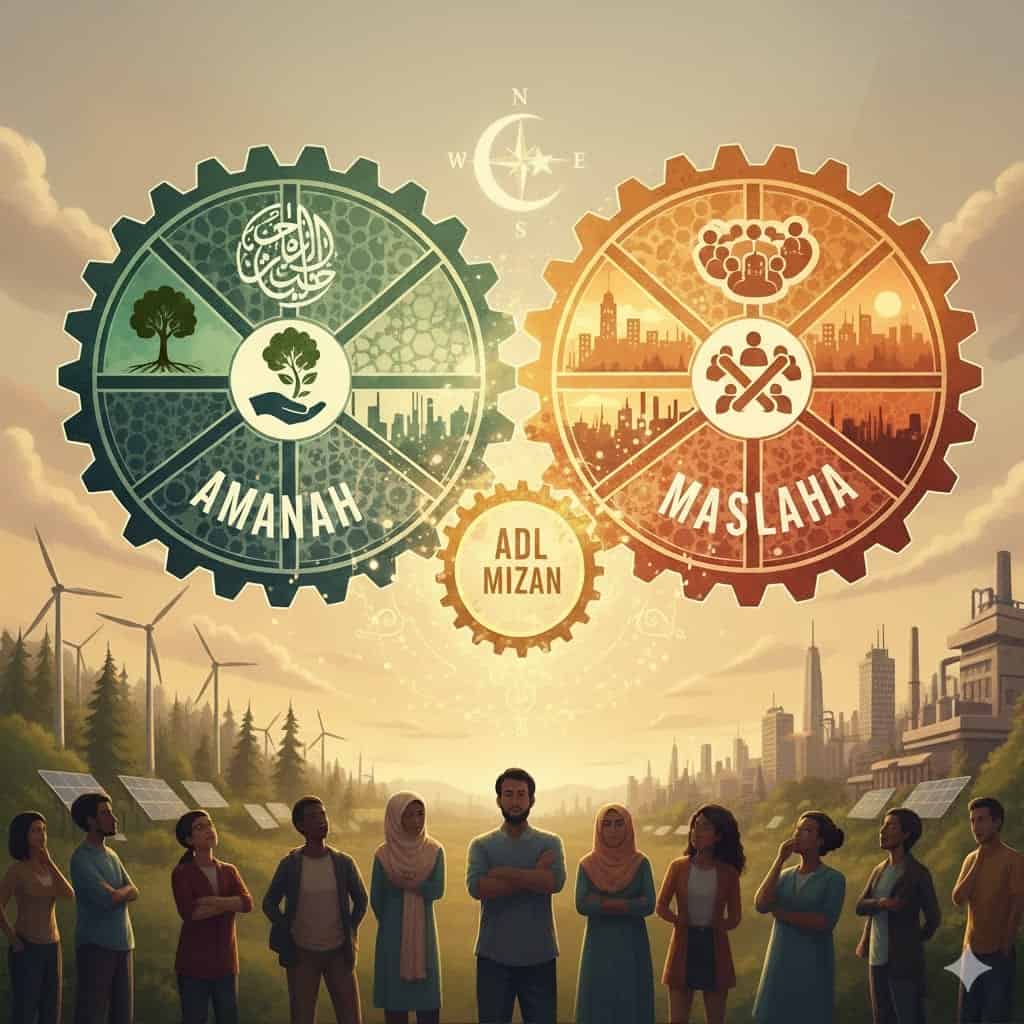
In the secular realm, we often rely on the myth of the Rational-Choice Theory, believing that given enough data, people will naturally converge on the optimal solution. This assumption crumbles when the fundamental issue is a clash of non-negotiable values. Consider the real-world debate over environmental policy and economic development. For one community, the deepest value is Stewardship (Amanah) of the Earth, a core Islamic teaching reflected in the Prophet’s (PBUH) saying,
“If the Final Hour comes while you have a sprout in your hand and it is possible to plant it before it comes, then you should plant it.”
Their value prioritises the health of the ecosystem and future generations. But for a neighbouring, resource-dependent community, the paramount value is Sustaining Life (Hifz al-Nafs) – providing immediate jobs, food, and stability through resource extraction.
For instance, if we had to decide between building a much-needed school on a small piece of historically sacred land or choosing a costlier, distant alternative. The value of education and development (‘Ilm) would come to clash violently with the value of preserving heritage and sanctity (Hurmah). Facts about soil stability would be irrelevant. The conflict would be purely consequential, causing painful divisions because both sides would hold that they were defending a righteous, Islamic value.
“The friction isn’t over facts, but over which deeply-held value should take precedence when an action is required..”
Public Health and the Clash of Communal vs. Individual Good
One of the most profound contemporary examples of a consequential conflict is the debate over public health measures, such as mandatory vaccinations or restrictions during a pandemic. This centres on the clash between the communal obligation and individual freedom.
From an Islamic perspective, the Principle of Public Interest (Maslaha – often translated as Public Interest or General Welfare) is one of the secondary sources of Islamic Law (Shari’ah) used by jurists to derive rulings when the primary texts (Qur’an and hadith) are not explicitly clear on a new issue. holds immense weight. The preservation of the community and the prevention of harm (Darar) is considered a collective obligation. The Prophet (PBUH) outlined this principle clearly when describing an illness:
“Do not put a sick person with a healthy person.”
This is the value of prioritising the well-being of the collective body. Conversely, the value of individual autonomy and informed consent – a manifestation of the honour and dignity Islam affords every person – is also deeply embedded. When a public health mandate is issued, those who dissent are not necessarily rejecting the facts; they are defending their value of personal liberty and sovereignty over their bodies, which they see as an Amanah, often translated as Trust or Stewardship, a foundational concept in Islam, emphasising the human role as a trustee of Allah (SWT) over all resources, talents, and even one’s own body.
“From an Islamic perspective, the Principle of Public Interest (Maslaha) holds immense weight… The resolution lies not in compromise, but in a novel synthesis that honours both concerns.”
Perspective-Taking (Tafakkur)
To resolve these consequential conflicts, we must move beyond merely stating facts and engage in true perspective-taking (Tafakkur), which in Islamic ethics means reflecting deeply on the divine wisdom behind the conflicting values. The solution is rarely an “either/or” compromise, but a novel synthesis that honours both concerns.
In the environmental policy debate, the novel solution isn’t halting development entirely or destroying the environment completely. It is realising that the value of Stewardship and Sustaining Life are two sides of the same Mizan. A novel solution requires an Islamic ethical theory of sustainable development – a framework that mandates resource use but enforces equally strict ecological restoration, ensuring the immediate needs of the poor are met without compromising the rights of future generations. It requires innovative, eco-friendly industrial practices, not simply choosing a winner between the two values.
Consequential conflicts are a test of our faith and wisdom. They force us to understand that different people, striving for righteousness, may interpret their obligations differently. The true Islamic response is not to judge one value as wrong, but to find the higher principle of justice that can harmonise them, moving from painful division to a balanced, sustainable societal solution.
When values clash, the Principle of Maslaha requires us to prioritise the action that protects a value higher up on the Dharuriyyat list, or, if two actions address the same level, to choose the one that prevents the greater harm to the largest number of people.
Values Collide in a Populous World
The consequential conflict – the clash of fundamental, deeply held values – is magnified exponentially in a world straining under the weight of eight billion people. The finite nature of the Earth’s resources makes the collision between individual freedom and collective necessity not just academic, but existential. Drawing parallels to the principles of Maslaha (Public Interest) and Amanah (Stewardship), we see how global population dynamics force a brutal reckoning on the scales of justice (Mizan).
The most glaring consequential conflict amplified by population size is the collision between the value of Affluence and Unlimited Choice (tied to economic liberty and individual property rights) and the value of Equitable Access to Basic Needs (tied to the preservation of life and social justice).
From the lens of global Maslaha, the collective well-being of the world community requires prioritising the Dar?riyy?t (Necessities) for all. When the Tahsiniyyat (Enhancements/Luxuries) of a small segment actively undermine the Dharuriyyat (Life, Property, Intellect) of the majority, the consequential conflict demands that the value of equitable distribution must temper the value of unrestricted individual consumption. The challenge is finding an ethical theory that respects legitimate individual property rights while imposing a limit rooted in the global common good.
When values collide, Maslaha provides a hierarchical framework (prioritising necessities over needs), while Amanah provides a relational framework (seeing the conflicting parties – individual, community, and environment – as co-trustees under Allah (SWT)). Together, they push us toward a just and novel solution, rather than a mere, unsatisfying compromise.
Recent posts
- Essay #10: Navigating Modernity with Timeless Virtues

- Eye of the Storm

- Courage matters. Being different matters.

Search by date
Writers Panel | A Simple Thought | Obituaries | Ziarat Ashura | Islamic Calendar | Facebook


