
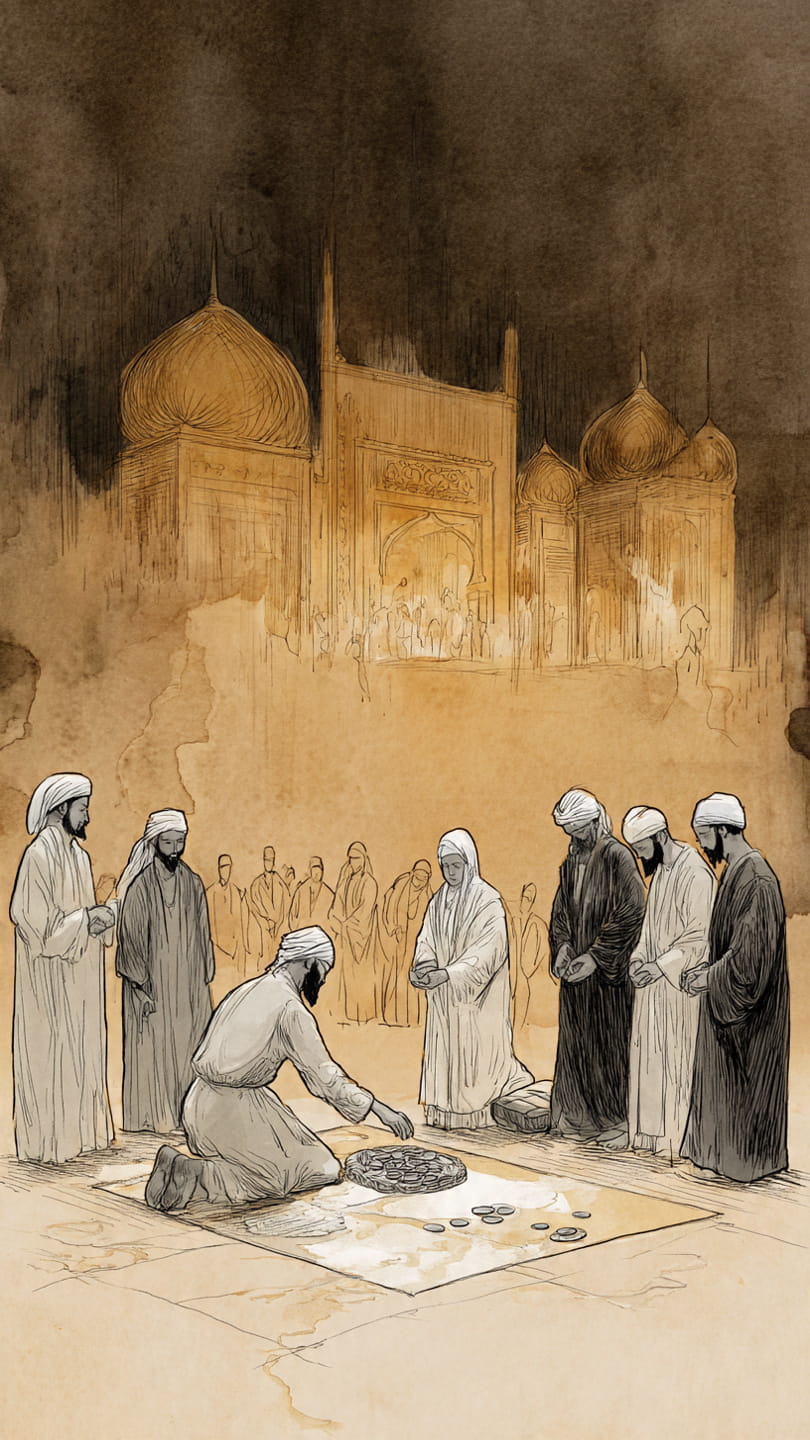
Economic Justice – Redistribution of state resources and confrontation with entrenched wealth.
Economic Justice & Leadership Accountability
 Mohamedarif Mohamed Suleman (Dar es Salaam, Tanzania) is a digital marketing specialist and an Educator-cum-Trainer. He has involved himself in community organisations and matters from a young age, and through his writings, continues to speak of social and cultural reform to this day. He is also the founding moderator of this forum (1996).
In many societies, leadership slowly mutates into a claim on privilege. The title itself begins to mean access: access to better stipends, to closed doors, to a standard of living sealed off from the people being led. The ruler’s house grows taller, his table richer, his distance wider, and this is called authority. For Imam Ali (AS), that equation was upside down. To him, authority was not entitlement but burden, and the first sign that a government had lost its way was when its leaders lived beyond the means of the masses while guarding the public purse as if it were their own.
When Imam Ali (AS) took the caliphate, the public treasury had become a symbol of rank. Certain names received more because they were earlier, closer, louder, or simply more feared. The Bayt al-Mal was treated like a private account that trickled down to the people at the ruler’s discretion. Imam Ali tore up that logic. He declared the treasury a trust held for the community and refused to let it sleep even one night with coins inside. Each Friday, he emptied it, distributed every dirham, and then swept the floor with his own hands, thanking God that he left as he had entered: with nothing that belonged to the people. If funds arrived at dusk, he lit torches and divided them then and there, saying no one could guarantee he would live until morning. The urgency was not theatre. It was a statement that public wealth belongs to the public, and delay is a kind of theft.
This practice struck directly at entrenched wealth. By erasing the old classes of stipends and returning to equal shares, he removed the financial architecture that had made leadership synonymous with luxury. The men who had grown comfortable with privilege felt the ground shift. Some came to him offended: how could a former master receive the same share as the man he once owned? Others complained that their lineage, their early service, and their tribal weight were being ignored. He answered them without speeches, by handing out the same portion to both men the next day. To equate leadership with special privileges, he showed, is to replace service with extraction. It turns the ruler into a rival of the poor, competing for the same resources he is meant to distribute.
The contradiction is stark: economic justice cannot coexist with a leadership culture that insulates itself from the economic reality of the people. If the one who holds the trust eats food the poorest cannot afford, wears what they cannot touch, and sleeps behind walls they cannot approach, then every policy he signs will drift toward protecting that distance. The compass fails. Imam Ali tied his own consumption to the poorest in his realm for that reason. He refused a woollen blanket from the treasury on a cold night and kept his meals simple, saying he wanted to feel and suffer like the people he governed. This was not an ascetic performance; it was a guardrail. When a ruler’s daily life depends on the same bread as the labourer’s, it becomes impossible to legislate as though bread were abstract.
He extended that standard to everyone around him. His brother came asking for help from the public funds and was told he could have something from Imam Ali’s personal share, but not from the Bayt al-Mal. The point was not cruelty to family; it was clarity about ownership. Public wealth was not a favour to be dispensed by proximity to power. To treat it that way is to turn justice into patronage and to replace right with relationship. Once that happens, the treasury becomes a tool for buying calm, for silencing dissent, for rewarding loyalty. It stops circulating. It pools. And when wealth pools at the top while poverty spreads at the base, the society is already confessing that injustice has been institutionalised.
Imam Ali (AS) confronted that directly. He confiscated properties taken unlawfully and cancelled appointments handed out as gifts. He told his governors that leadership was a trust on their necks, not bait for personal gain. He reminded them that the people are either brothers in faith or equals in creation, so no policy could be tribal, no distribution could be based on blood or status. When two women came for their shares, one Arab and one non-Arab, he gave both the same. When critics objected, he said he found no difference between them. The principle was simple: if leadership means anything, it means being the first to relinquish privilege, not the first to claim it.
This is where the spirit of service collides with the culture of entitlement. Service bends down; entitlement stands apart. Service measures itself by how little separates the ruler from the ruled; entitlement measures itself by how much. Imam Ali’s government was unstable by the metrics of realpolitik because he refused to stabilise it with injustice. He would not pay elites from the treasury to keep their swords sheathed. He would not build a palace with public money and call it administration. He understood that a state that asks its people to tighten their belts while its leaders loosen theirs is not asking for sacrifice; it is demanding submission.
The legacy, then, is not only about redistributing coins. It is about redefining leadership itself. Economic justice begins when the ruler stops seeing his position as a license to live above the people and starts seeing it as an obligation to live among them. Imam Ali’s empty treasury was the outward sign of that inward posture. He left the Bayt al-Mal with nothing because he believed he had come to the caliphate with nothing that was not already owed. In that equation, full justice requires empty vaults, and true authority looks less like a crown and more like an open hand.
Recent posts


Search by date
Writers Panel | A Simple Thought | Obituaries | Ziarat Ashura | Islamic Calendar | Facebook


