
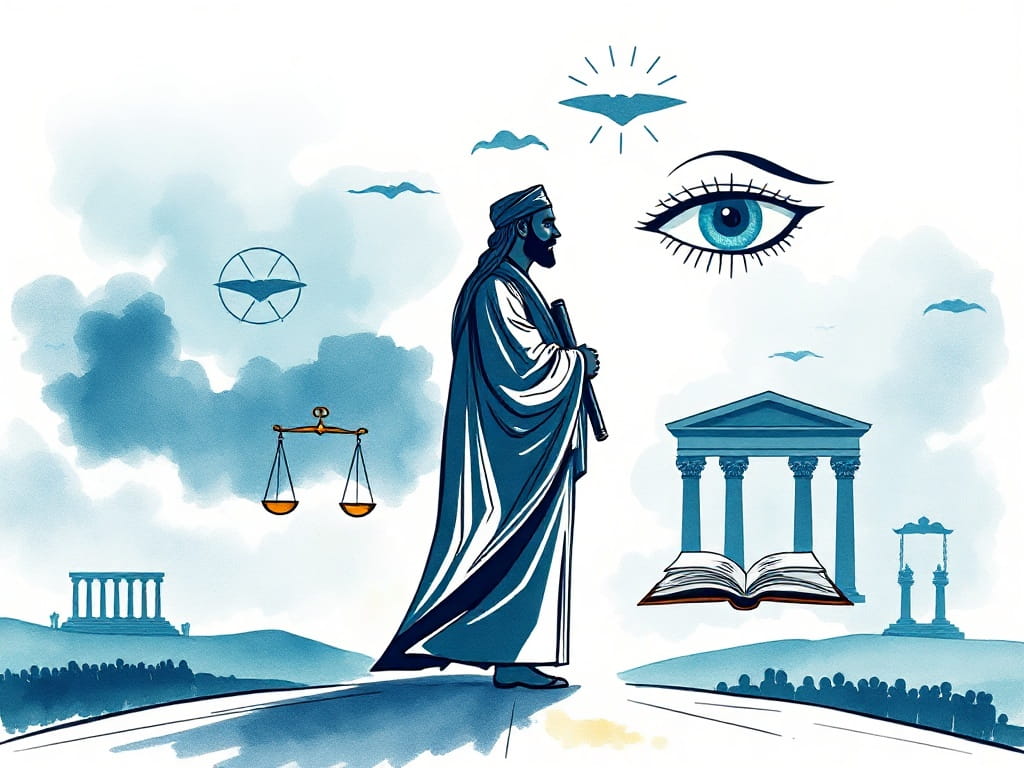
Ethical Governance
Lessons from Imam Ali’s Caliphate for Leaders Facing Political Polarisation, Disinformation, and Eroded Public Trust
 Mirza Rizwan Ali Baig (Hyderabad, Telangana, India) is a researcher and writer focused on Islam and Astronomy. A member of both NASA STEM and the Royal Astronomical Society (RAS), his work in science outreach and religious thought is inspired by the wisdom and teachings of Imam Ali (AS), guiding his efforts to explore the intersection of faith and knowledge. He is on a personal journey to relearn Islam, recognising how cultural influences, especially in South Asia, have shaped the understanding of the religion.
P
olitical authority is never sustained by power alone. A ruler may command institutions, enforce laws, and defeat opponents, yet still fail to govern ethically if the public no longer believes that authority is tied to justice. The deeper crisis of governance begins when legality and legitimacy separate: when a state can still act, but can no longer persuade its people that its actions are morally trustworthy.
This distinction matters because governance is not merely administrative. It is moral. Laws and institutions can organise public life, but they cannot by themselves generate trust. Trust depends on the belief that power is being exercised with fairness, restraint, and accountability. When that belief collapses, citizens begin to interpret every decision through suspicion. Policy becomes factional, truth becomes negotiable, and opposition becomes existential.
Political polarisation intensifies this problem. A divided society does not only disagree over policies; it loses a shared framework for judging truth and justice. Disinformation thrives in this environment because it feeds on distrust. Falsehood becomes persuasive not merely when it is repeated, but when people are already prepared to believe that institutions are corrupt, leaders are deceptive, and opponents are acting in bad faith.
It is within this wider problem of legitimacy under crisis that the caliphate of Imam Ali ibn Abi Talib becomes politically instructive. His rule was not exercised in a settled society, but in a fractured community marked by civil conflict, competing claims of justice, elite resistance, propaganda, and public confusion. For that reason, his caliphate should not be read only as a devotional memory but also as a serious case study in ethical governance under conditions of instability.
Imam Ali’s leadership shows that the deepest crisis of governance is not disorder itself, but the temptation to answer disorder by abandoning justice. His caliphate offers a model in which authority is treated not as possession, but as trust; not as domination, but as responsibility; not as a licence to defeat enemies by any means, but as a moral burden constrained by truth, fairness, and accountability.
Justice and the Basis of Legitimacy
One of the central lessons of Imam Ali’s caliphate is that political legitimacy cannot be separated from justice. In his understanding, governance was not a private possession of the ruler, nor a reward for political loyalty. It was a trust. The ruler was responsible not only for maintaining order, but for ensuring that order did not become a mask for oppression.
This is important because an unjust order is still disorder at a moral level. A society may appear stable while its institutions favour the powerful, ignore the vulnerable, or protect corruption. Such stability is fragile because it rests on fear, dependence, or exhaustion rather than genuine trust. Imam Ali’s rule challenged this kind of stability by refusing to treat injustice as acceptable simply because it had become politically normal.
This was especially clear in his approach to public wealth and political privilege. He rejected unequal distribution based on status, tribal influence, or elite expectation. This created opposition from those who believed that their social position entitled them to special treatment. Yet the ethical point is precisely that justice is tested when it becomes costly. A leader who supports justice only when it is politically safe has not made justice the foundation of governance; he has made it a decoration of power.
For modern leaders, the relevance is direct. In polarised societies, governments often try to preserve support by satisfying loyal groups, protecting influential allies, or selectively enforcing rules. Such strategies may secure a temporary advantage, but they deepen the legitimacy crisis. Citizens begin to see institutions not as guardians of justice, but as instruments of factional control.
Imam Ali’s model suggests that trust cannot be rebuilt through slogans about unity. It must be rebuilt through visible fairness. People must see that law, public resources, and institutional respect are not distributed according to loyalty or power.
Ethical Consistency in Crisis
Crisis often produces a dangerous argument: that ordinary moral limits must be suspended because the situation is exceptional. Leaders may claim that deception is necessary, that opponents must be humiliated, or that the survival of the state requires methods that would otherwise be condemned. In this way, crisis becomes a permission structure for ethical collapse.
Imam Ali’s caliphate challenges this logic. His political environment was filled with pressure: civil conflict, rival claims of legitimacy, public confusion, and organised resistance. Yet his leadership did not separate political success from moral method. He did not treat victory as meaningful if it required the abandonment of justice.
This is one of the most philosophically important aspects of his governance. A leader’s methods are not external to his goals. They shape the kind of order that will emerge from his rule. If a leader uses lies to defend truth, he weakens the public meaning of truth. If he uses injustice to defend justice, he teaches people that justice is conditional. If he destroys moral limits in order to defeat disorder, he may defeat one crisis while creating a deeper one.
In modern politics, this issue is especially visible in the age of disinformation. Leaders are often rewarded for controlling narratives rather than clarifying reality. They may simplify complex issues, manipulate fear, or present opponents as enemies of the people. These strategies can be effective, but they corrode the moral foundations of public life.
Imam Ali’s example suggests that ethical governance requires consistency between ends and means. A just society cannot be produced through systematically unjust methods. Political success that depends on deception is not genuine; it is the transfer of corruption from one form to another.
Public Trust, Accountability, and Moral Clarity
Public trust is not created by demanding obedience. It is created when people believe that authority is answerable to moral limits. Imam Ali’s political thought places strong emphasis on accountability. The ruler is not above correction. Authority increases responsibility; it does not remove scrutiny.
This idea appears clearly in his instructions to governors, especially in the famous letter to Malik al-Ashtar. In that letter, governance is framed as a moral duty toward the people. The ruler must be attentive to the vulnerable, careful in appointing officials, cautious of flattery, and aware that power can corrupt judgment. The people are not treated as a population to be managed, but as a trust to be served.
This is highly relevant to contemporary political distrust. Many people today do not simply disagree with leaders; they suspect them. They suspect that institutions are captured, that public language hides private interests, and that political decisions are shaped by parties, donors, corporations, religious factions, or ideological tribes. In such an environment, trust cannot be restored through public relations alone.
A leader who wants to rebuild trust must make accountability visible. He must allow criticism to reach him. He must distinguish between sincere advice and empty praise. He must avoid surrounding himself only with loyalists who protect him from uncomfortable truths. When leaders isolate themselves from criticism, they begin to confuse loyalty with competence and dissent with betrayal.
This also connects to the problem of disinformation. Disinformation is not merely an information problem; it is a trust problem. Falsehood becomes powerful when it enters a society already weakened by suspicion. People no longer ask, “Is this true?” They ask, “Whose side does this serve?”
Imam Ali’s response to political confusion was not counter-manipulation, but moral clarity. His speeches and letters repeatedly returned to first principles: justice, truth, responsibility, humility before God, and the temporary nature of worldly power. This was not abstract moralising. In a fractured political environment, people needed a framework through which they could judge claims, actions, and leaders.
Modern leaders facing disinformation must therefore do more than correct falsehoods. They must demonstrate that truth is not simply a weapon used when convenient. Moral clarity must not become propaganda. Propaganda demands loyalty to a narrative; moral clarity invites judgment according to principles.
Polarisation and the Ethics of Opposition
A polarised society does not merely contain disagreement. It transforms disagreement into identity. Political opponents are no longer seen as people with different judgments, interests, or fears. They are seen as threats to the moral order itself. Once that happens, the ethics of opposition collapse. Any method used against the opposing side begins to appear justified.
Imam Ali’s caliphate was deeply marked by opposition and conflict. Yet his treatment of opposition was not based on uncontrolled vengeance or dehumanisation. He recognised that conflict may sometimes be unavoidable, but he did not allow conflict to cancel moral boundaries.
This is a crucial lesson. Ethical leadership does not require naivety. Imam Ali did not deny that rebellion, manipulation, and factional ambition could damage the community. But he also did not reduce every opponent to absolute evil. His approach preserved the distinction between firmness and cruelty.
Modern leaders often fail precisely at this point. They either become weak in the face of destructive actors or morally reckless in the name of order. The first response allows chaos to grow. The second destroys the ethical legitimacy of the state. Imam Ali’s model offers a more disciplined alternative: confront harm, but do not abandon justice; resist disorder, but do not become unjust in the process.
This matters because the way a leader treats opponents shapes the political culture of the wider society. If the leader speaks with contempt, citizens learn contempt. If the leader lies about opponents, citizens learn that truth is secondary to victory. If the leader presents every critic as an enemy, public reasoning becomes impossible.
Ethical governance requires the leader to maintain moral distinctions when polarisation tries to erase them. Not every critic is a traitor. Not every supporter is sincere. Not every compromise is a weakness. Not every act of firmness is oppression.
Power as Trust, Not Possession
A major theme in Imam Ali’s governance is the danger of power itself. Power not only reveals character; it can deform it. It can persuade leaders that their survival is identical to the survival of the community. It can make criticism appear like betrayal and restraint appear like weakness. It can turn public office into personal entitlement.
This is why self-restraint is central to ethical leadership. A ruler must be capable of acting, but also capable of limiting himself. He must be strong enough to govern, but not so attached to strength that he forgets justice. Imam Ali’s model shows that restraint is not the opposite of power. It is the moral discipline that prevents power from becoming tyranny.
Modern politics often defines strength as domination: controlling the message, defeating opponents, avoiding apology, and never appearing vulnerable. But this is a shallow understanding of strength. A leader who cannot admit error is not strong; he is fragile. A leader who cannot tolerate criticism is not secure; he is dependent on praise. A leader who must lie to maintain authority has already weakened the moral basis of that authority.
Perhaps the most important lesson from Imam Ali’s caliphate is that leadership is a trust, not a possession. The ruler does not own the state, the treasury, the people, or the truth. Authority is temporary, but its moral consequences are lasting.
This principle directly challenges modern political entitlement. Leaders often behave as though electoral victory, religious symbolism, party loyalty, or institutional rank gives them unrestricted permission to rule as they wish. They confuse access to power with moral ownership of power.
Imam Ali’s model rejects this confusion. Authority remains bounded by justice. Public wealth remains public. The dignity of people remains protected. Truth remains truth even when it is politically inconvenient. The ruler’s personal interest cannot become the measure of the public good.
Lessons for Contemporary Leaders
Imam Ali’s caliphate does not offer a simple political formula. It does not suggest that ethical leadership will remove conflict or guarantee immediate success. In fact, his life shows the opposite: principled leadership may intensify opposition from those who benefit from injustice. Yet this is exactly why his example is so important. It separates moral success from mere political convenience.
Several lessons can be drawn for contemporary leaders.
First, justice must be visible. Citizens must be able to see that rules apply across status, wealth, faction, and identity. A government cannot rebuild trust while protecting allies from accountability.
Second, truth must not be sacrificed for strategic advantage. Once leaders treat truth as a tool of factional success, they contribute to the very disinformation crisis they claim to oppose.
Third, opposition must be handled with ethical discipline. Leaders must confront harmful actions without turning political opponents into permanent enemies.
Fourth, accountability must be real. Leaders need institutions, advisors, critics, and public mechanisms that allow truth to reach power. A ruler surrounded only by praise becomes incapable of self-correction.
Finally, power must be restrained. A leader who sees people as a trust will govern with respon- sibility; a leader who sees power as possession will eventually govern for self-preservation.
More from this Author
Writers Panel | A Simple Thought | Obituaries | Ziarat Ashura | Islamic Calendar | Facebook | Instagram


