


The speaker has lived, studied, and worked in the UK, the Middle East, and Australia as an academic, lawyer, chaplain, and community worker. He researches Islamic and Western Law, focusing on the subjects of law, scripture interpretation, moral development, and access to justice and human rights for minority communities. His country’s expert reports have been commented upon by judges and lawyers and draw upon his diverse legal, cultural and religious experiences.
Dr Panjwani is the Head and Founder of Diverse Legal Consulting, a consultancy that specialises in country expert reports on the Middle East & North Africa (MENA) for asylum seekers. Drawing upon his seminary and university studies, his work cuts across scriptural exegesis, jurisprudence, philosophy, logic and metaphysics. By re-examining the subject of the law, a critical evaluation of how laws are derived from religious and non-religious sources can take place. This also means broadening our notions of evidence to understand other legal systems better so that the dignity of minorities can be recognised. In his spare time, he engages in interfaith dialogue in Muslim and faith communities worldwide and likes playing tennis and doing charity work. He enjoys spending time with family and, when possible, escapes into the world of fantasy football and all other idiosyncratic creative outlets.
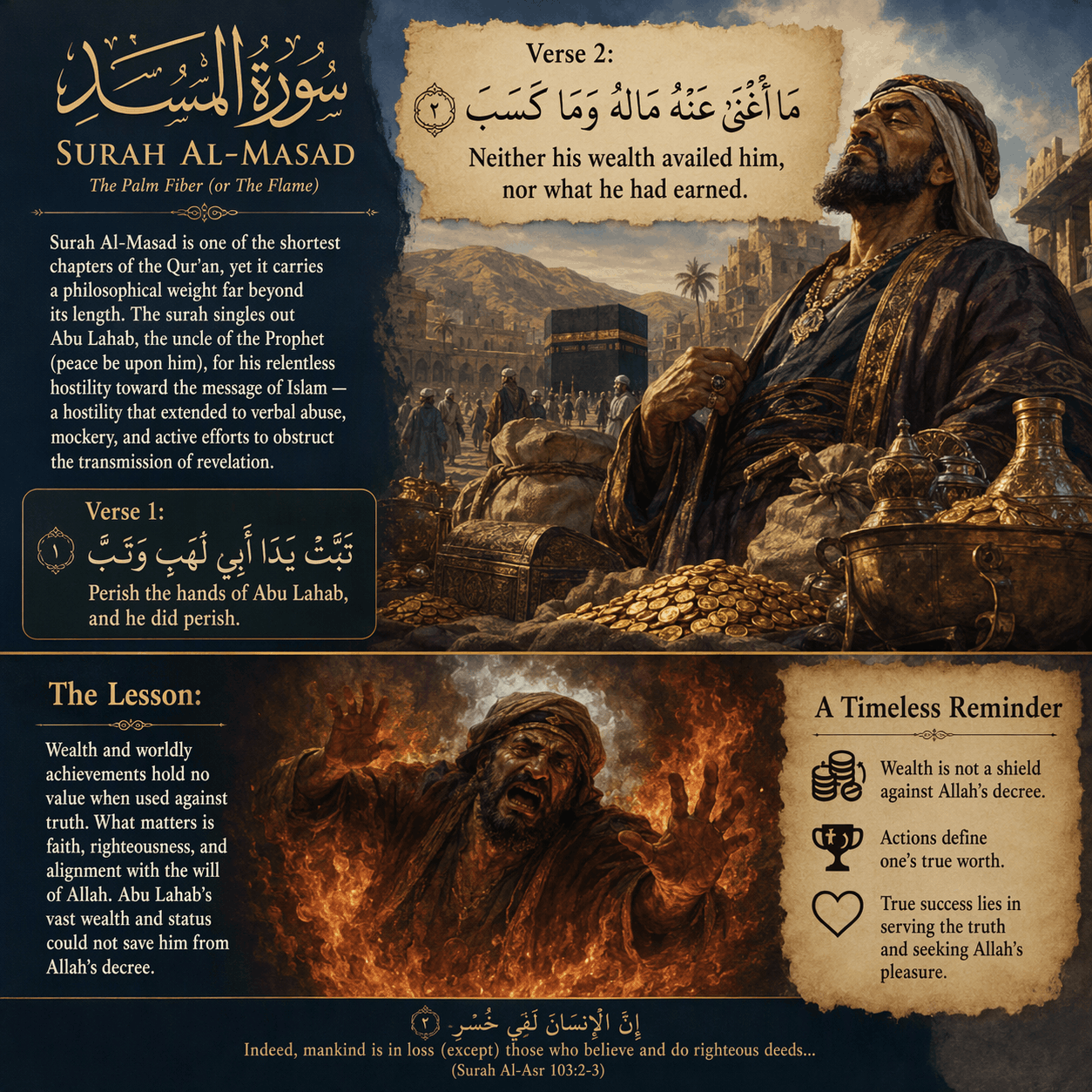
Reading Verse Two of Surah al-Masad – a transcript of his original lecture
At first glance, this is a simple sentence. Yet a closer reading – first through its meaning, and then through its grammar – opens onto some of the Qur’an’s most enduring teachings on cause and effect, on the true value of worldly success, and on the nature of disbelief itself.
The Cause Behind the Curse
Verse one condemns Abu Lahab; verse two explains why. There is already an implicit link between the “hands” of Abu Lahab – understood allegorically as his deeds – and his ultimate ruin. Verse two makes this explicit by turning to two of the very things a man like Abu Lahab would have considered his greatest assets: his wealth, and everything else he had acquired or achieved in life.
The verse can be read in more than one way. On one interpretation, the first half addresses his wealth specifically, while the second half – “what he had earned” – broadens the scope to cover any deed, whether it benefited himself, his family, or others. Even those actions performed in a seemingly neutral or generous spirit, done to provide for his household, are swept into this judgement: none of it will benefit him.
A second interpretation reads the verse as a unified statement about Abu Lahab’s relationship with the fire he is soon to enter – described just one verse later as “the blazing fire.” However much wealth or achievement Abu Lahab might point to, however much he might protest that his accomplishments were “valuable commodities,” none of it constitutes grounds for reprieve. He cannot bargain his way out of accountability by appealing to what he built in this world.
This, in turn, exposes what Abu Lahab was truly rejecting: not merely the Prophet’s message in the abstract, but its most fundamental claim – that there is one God, and that this God will judge every deed on a Day of Reckoning. Abu Lahab’s resistance was, at its core, a resistance to being held accountable.
From here a third, more universal lesson emerges – one directed not at Abu Lahab but at us. In the business of daily life, what the world prizes as valuable – wealth, property, even children and family (notably, Abu Lahab’s wife is condemned alongside him in the very next verse) – carries no independent power to secure salvation. If wealth alone determined one’s fate in the hereafter, the richest would ascend to heaven, and the poorest would be condemned to hell. Clearly this is not how divine justice operates. What matters is not the possession of these things but how they are used in service of God. Abu Lahab is the starkest illustration of this principle turned inside out: he used his wealth, his time, and his effort not to serve the message but to actively oppose it.
The Grammar of “Maa”: Four Ways to Read One Word
Beyond its plain meaning, the verse rewards closer grammatical study, particularly of the word maa? (“what” / “not”), which appears twice. Four distinct grammatical readings have been proposed, each subtly reshaping the verse’s implication.
1. Maa as negation. The most straightforward reading treats m? simply as a negative particle – “not.” On this reading, the verse states plainly: his wealth did not avail him, and what he earned did not avail him either. This is the sense followed by most standard translations, including the widely used rendering of Abdullah Yusuf Ali.
2. Maa as a relative pronoun. Alternatively, m? can function as a relative pronoun – “that which” or “what” – connecting to an implied clause. Under this reading, the verse becomes an inquiry into the content of what he earned, rather than a flat denial of its worth. Commentators note that “what he earned” here carries a specific historical resonance: in Arabic idiom, a man’s earnings can refer to his children, and particularly his son. Read this way, the verse gains an added edge – not even his offspring, in whom he had invested so much hope, will make any difference to his fate. The emphasis falls not on negating his wealth outright but on underscoring that whatever he has accumulated – sons included – simply will not matter when he enters the fire.
3. Maa as a marker of the infinitive (masdariyyah). A third reading treats m? as transforming the following verb into a verbal noun without tense – comparable to the way the bare word “run” in English carries no indication of past, present, or future. On this reading, the verse speaks of whatever benefit is being drawn or will be drawn from his wealth and earnings, at any point in time, past or future. This widens the verse’s scope: no matter when the gain occurred or will occur, it changes nothing about his ultimate destination.
4. Maa in the sense of rhetorical negation (istifhaam inkaar?). A fourth possibility reads the phrase as a rhetorical question posed in a spirit of rebuke – “What could his wealth avail him, and what he earned?” – a negative statement delivered in interrogative form for emphasis, much as one might say “How could you dare?” to convey outrage rather than genuine inquiry.
Each reading shifts the verse’s emphasis slightly – from flat denial, to a pointed remark about his son, to an atemporal statement encompassing all his gains, to a rhetorical rebuke – yet all converge on the same conclusion: nothing Abu Lahab possessed or acquired could shield him from the consequences of his defiance.
Al-Shirazi’s Reading
The exegete al-Shirazi draws a memorable conclusion from this verse: that it reveals Abu Lahab to have been “a rich, proud man who used to rely on his own property and wealth in his efforts to oppose Islam.” This reading highlights two intertwined dimensions of Abu Lahab’s character. First, his pride and stubbornness were themselves a cause of his ruin – an arrogance that made submission to the new message unthinkable. Second, and more specifically, he weaponised the very instruments that ought to have been used for good – his wealth and social standing – turning them instead into tools of opposition against God.
This distinction between mere disbelief and stubborn, weaponised disbelief resonates with a further point raised by some contemporary Shia scholars: a distinction between the “intentional” disbeliever and the “unintentional” one. Abu Lahab exemplifies the intentional disbeliever – one who, through character and resources, vehemently and knowingly opposes God. The unintentional disbeliever, by contrast, arrives at disbelief through honest inquiry, without stubbornness, and without malice toward the truth; he or she may in time be guided, or may not, but bears no resemblance to Abu Lahab’s calculated hostility. Such a person, it is argued, deserves to be met with respect and good conduct, since their position stems from reasoning rather than defiance.
Cause and Effect: From the Qur’an to Newton
Verse two, ultimately, is a meditation on causation – on how deeds, and the intentions behind them, produce consequences. This invites a broader look at what the Qur’an says about cause and effect more generally.
Surah al-Zalzalah offers perhaps the clearest statement of the principle: “So whoever does a good deed equal to the weight of the minutest particle will see it, and whoever does an evil deed equal to the weight of the minutest particle will see it.” This establishes a foundational rule – every deed, however small, however brief, however seemingly insignificant, generates a consequence that will eventually be witnessed. A smile costs almost nothing, yet even it registers; a frown, likewise, is never truly without effect.
There is a striking, if informal, parallel here with Newton’s third law of motion: for every action, there is an equal and opposite reaction. If one object exerts force upon another, the second exerts an equal force in return – push a chair, and the chair pushes back; walk on the ground, and the ground pushes back against your foot. Extending this analogy to human conduct, one might say that every good or bad deed likewise generates some responding force in the world. This should not be read too literally or too optimistically: smiling at someone does not guarantee they will smile back — the “reaction” one receives is not necessarily of the same moral quality as the original act. But a reaction of some kind is guaranteed. The Prophet’s own life illustrates this: his truthfulness and trustworthiness earned him the trust of his society, yet as his message came to be seen as a threat to entrenched interests, he received in return persecution or opposition from figures like Abu Sufyan. The force returned was not identical in kind to the force given, but a force there certainly was.
A further principle concerns when these effects are seen. The Qur’an suggests that the consequences of our deeds unfold on two planes: this world and the next. As stated elsewhere, “whoever acts righteously, whether male or female, and is a believer, We shall surely make him live a good life, and We will certainly reward such people in accordance with the best of their deeds.” This is read by some as promising a twofold reward – a good life experienced here, in this world, and a further reward awaiting in the hereafter. Even a good deed of the briefest duration or the smallest apparent value thus carries a longevity that outlasts the moment of its performance, echoing into both this life and the life to come.
Conclusion
Read together, the grammatical richness of verse two and its philosophical undercurrents point to a single, unified lesson. Wealth, achievement, offspring, and worldly acquisition carry no independent power to secure salvation; their value lies entirely in how they are used in service of God. Abu Lahab stands as the clearest counter-example – a man who possessed every worldly advantage and turned each one against the very message that could have saved him. And beneath this specific case lies the universal principle the Qur’an keeps returning to: nothing is without consequence. Every deed, weighed even to the measure of the smallest particle, will be seen – in this world, and in the next.
Recent posts
- True self-development
 True self-development by Asgar Jafferali Dhanji While physical growth is easy to see, your mind, character, and professional capability evolve in ways that are much harder to gauge. If you look back five years, you are likely not the same person you were then. You are constantly evolving, but reaching the next level of your personal development requires conscious, deliberate action.
 - Adl
 Adl by Sheikh Fattah The concept of justice (‘Adl) occupies a foundational position in Islamic theology and ethics, serving as a lens through which the relationship between the Creator and creation is understood. In his insightful essay, “Adl – Justice and Decree,” originally published in the spring 1984 issue of the journal Nuradeen, Sheikh Fattah provides a concise yet profound exploration of this multi-faceted principle. Drawing extensively from the Holy Quran and the narrative traditions (ahadith) of the Ahlul Bayt – specifically Imam Ali and Imam Ja’far as-Sadiq—the author dismantles the complexities surrounding divine decree, free will, individual morality, and structural social justice. The text functions not merely as an academic exposition of theological doctrine, but as an ethical manifesto that bridges metaphysical truths with practical human responsibility.
 - Eternal Life
 Eternal Life by Ayatullah Murtadha Mutahhari Ayatullah Murtadha Mutahhari’s Eternal Life is a concise but profound exploration of one of Islam’s central beliefs: that human life does not end with death. Drawing on the Qur’an, hadith, Islamic philosophy, and rational argument, Motahhari presents the Hereafter not as a distant abstraction but as the destination that gives meaning to every thought, choice, and action in this world. The book is especially valuable for readers seeking a clear, reasoned introduction to Islamic teachings on death, the soul, barzakh, resurrection, and eternal life.


