
The writer is the Head of the Khoja Heritage Project of The World Federation of KSIMC. A lifelong educator and historian, he has dedicated over three decades to documenting the rich, socio-religious journey of the Khoja Shia Ithna-Asheri community. His landmark documentary, The Khojas – A Journey of Faith, traces this evolution across 600 years. Over the past 30 years, he has been collecting care Gujarati and Khoja history books housed at the Mulla Asghar Memorial Library in Toronto, which he co-founded with Raza-Aly Hiridjee.
Serving for almost half a century, he had been the former Secretary General, Vice President, and President of The World Federation. Professionally, he is a nutritionist and has also authored 26 books on naturopathic medicine, translated into several languages. As Executive Director of the United Global Initiative and a Trustee of the Jaffer Family Foundation, he leads the CodeGirls project, which empowers underprivileged girls to pursue technology careers. He has also been instrumental in facilitating the ‘Ashura at Harvard’ study track at Harvard Divinity School, promoting academic discourse on Shi’ism, fully funded through the Jaffer Family Foundation.
Ashura has passed.
The black banners still hang.
The matam still echoes in the body.
The noha still trembles somewhere between memory and conscience.
The name of Husayn (a.s.) still rests on the tongue.
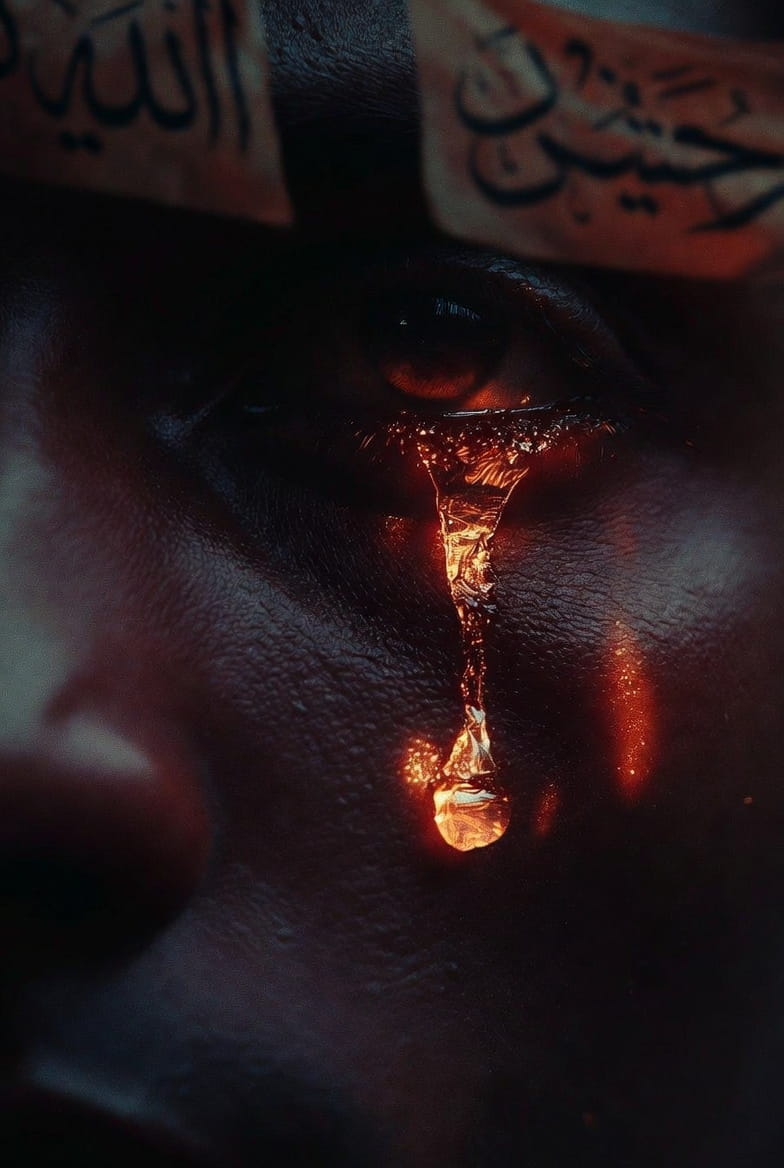
And the tears have fallen.
But now the question begins.
Not: did we cry?
That is too easy.
The question is:
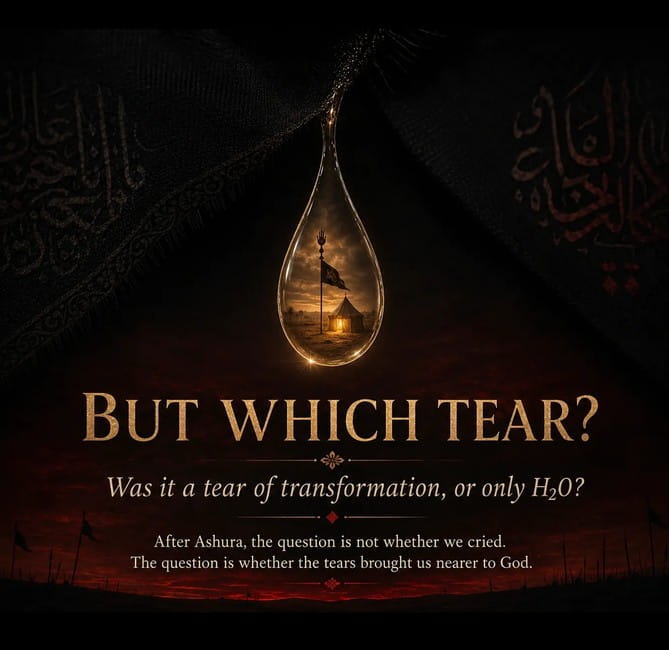
What kind of tear was it? Was it a tear that rose from the soul? Or was it only water?
Not simply the sound of mourning. Not merely the rhythm of majlis, marsiya, noha, and tears. These are sacred forms. They carry memory. They gather the community. They teach the next generation how to remember.
A tear, chemically speaking, is not mysterious. It is mostly water. It carries salts, oils, enzymes, proteins, and traces of the body’s inner condition. Science will tell us that tears lubricate the eye, protect it from infection, and respond to irritation, pain, or emotion.
The body knows how to produce tears.
But Karbala asks something far deeper:
Can the soul produce a tear?
Because the eye can weep without the heart changing.
The body can tremble without the conscience awakening.
The cheek can become wet while the ego remains dry, hard, polished, and perfectly intact.
There are tears of biology.
And there are tears of becoming.
There are tears that are only fluid.
And there are tears that are a form of witness.
This is where Ayatollah Mutahhari’s words become so piercing.
“If we shed tears for Imam Husayn (a.s.), it ought to be in the harmony of our spiritual state with Imam. If our soul ascends a little with Imam Husayn (a.s.), and a little from his endeavor, a little from his honor, a bit from his liberation-seeking, a bit from his faith, a bit from his piety and a bit of his monotheism radiates in us and while in this state a tear sheds from us, then it is valued to whatever you desire it to be valued! And if now it is said that a tear, the size of the wing of a fly, has the value of the entire world, believe it.”
– Ayatollah Murtaza Mutahhari
He does not reduce the tear for Husayn (a.s.) to emotion. He elevates it into a spiritual event. A tear has value when it is in harmony with the state of Imam Husayn (a.s.). Not merely when it is shed in his name. Not merely when it falls during a majlis. Not merely when it arrives with rhythm, memory, and the collective grief of the gathering.
It has value when something of Husayn (a.s.) enters us.
A little of his honour.
A little of his truth.
A little of his freedom from fear.
A little of his refusal to bow before falsehood.
A little of his nearness to Allah.
Then the tear becomes more than chemistry.
It becomes testimony.
It becomes a small drop of moral revolution.
Because the tragedy of Karbala is not only that Husayn (a.s.) was killed. The deeper tragedy is that an age had become spiritually numb enough to kill him.
That is the horror.
Not swords alone.
Not thirst alone.
Not the burning plain alone.
The horror is the death of recognition.
People saw truth and called it rebellion.
They saw dignity and called it danger.
They saw the grandson of the Prophet and chose the comfort of power.
And here we are, centuries later, weeping over them.
But Karbala turns toward us and asks:
Are you so different?
A cruel question.
Naturally, the kind humans avoid by organising another majlis.
Do we not also recognise truth and delay it?
Do we not see injustice and rename it complexity?
Do we not see the lonely and call them inconvenient?
Do we not see the oppressed and ask whether speaking up might disturb our position, reputation, comfort, or carefully managed social life?
This is why the tear for Husayn (a.s.) is dangerous.
If it is real, it will not leave us alone.
It will enter the bloodstream of the soul.
It will disturb the chemistry of our habits.
It will alter the pH of our conscience.
It will make arrogance acidic.
The true tear is not passive.
It is not sentimental decoration.
It is not religious moisture.
It is a solvent.
It dissolves the crust around the heart.
It washes away the dust of routine worship.
It breaks down the salt of pride.
It exposes the hidden impurities of the self.
It reveals how much of our religion is habit, how much is culture, how much is performance, and how little may actually be surrender.
That is why not every tear reaches Husayn (a.s.).
Some tears fall downward only.
They begin in the eye and end on the cheek.
But the tear Mutahhari speaks of falls upward.
It begins in grief, but rises into ma‘rifah.
It begins in mourning, but rises into reform.
It begins in sorrow, but rises into tawhid.
Such a tear is not measured by volume.
A thousand tears may weigh nothing.
One tear may outweigh the world.
Not because of its size.
Because of its direction.
Where did it take you?
Did it take you closer to truth?
Did it take you closer to humility?
Did it take you closer to the courage of Husayn (a.s.)?
Did it make falsehood harder to tolerate inside yourself?
If yes, then even a tear the size of the wing of a fly can become priceless.
But if the tear dries and nothing changes, then we must be honest.
Perhaps it was only H?O.
The chemistry of the tear may be correct, but the spirituality may be absent.
The salt was there.
The water was there.
The body performed its function.
But where was the soul?
Ashura is not meant to leave us emotionally exhausted and spiritually untouched. It is not a season in which grief is consumed, displayed, shared, forwarded, and then stored away until next year. Karbala is not an annual ceremony of sacred sadness. It is the interruption of every false peace.
It tells us that a human being can stand alone and still be with God.
It tells us that defeat in the eyes of empire may be victory in the sight of Allah.
It tells us that the body can be surrounded, but the soul can remain free.
And then comes Zainab (s.a.).
After the massacre.
After the tents.
After the chains.
After the court of arrogance.
She stood before power and refused to let power define what had happened. When asked what she had seen, she replied:
“I saw nothing but beauty.”
This was not denial.
This was vision.
Zainab (s.a.) saw beyond the surface of tragedy. She saw that what is given for Allah is never lost. She saw that bodies may be wounded, but truth cannot be humiliated. She saw that the empire could kill, parade, imprison, and mock, but it could not interpret Karbala.
She took the tear of Ashura and gave it language.
Without Zainab (s.a.), grief could have remained grief.
With Zainab (s.a.), grief became witness.
That is the second test of our tears.
Do they give us vision?
Do they help us see beauty where the world sees defeat?
Do they help us see God where the eye sees only loss?
Do they help us speak when silence would be easier?
Do they help us stand when standing has a cost?
A tear for Husayn (a.s.) without the courage of Zainab (s.a.) remains incomplete.
It mourns the martyr but avoids the testimony.
And that is where many of us become uncomfortable. We prefer a Karbala that asks us to feel, but not a Karbala that asks us to change. We prefer tears without consequences. Grief without reform. Love without obedience. Religion without surrender.
A very convenient arrangement.
Karbala comes to soften hearts. But softness is not weakness. The softened heart is the heart most capable of truth. Stone does not feel pain, but it also cannot receive light.
The tear is the sign that the stone may be breaking.
But only if we allow it.
After Ashura, we must not ask only how much we cried.
We must ask:
What did my tear dissolve?
What did it cleanse?
What did it reveal?
What did it awaken?
What did it demand from me?
Did it dissolve my pride?
Did it cleanse my tongue?
Did it reveal my cowardice?
Did it awaken my conscience?
Did it demand a different life?
If not, then the tear did not complete its journey.
The tear that matters is the one that changes the one who sheds it.
So after Ashura, when the eyes have dried and the halls have emptied, one question remains:
Was it a tear for Husayn?
Or was it just H?O?
Recent posts
- True self-development
 True self-development by Asgar Jafferali Dhanji While physical growth is easy to see, your mind, character, and professional capability evolve in ways that are much harder to gauge. If you look back five years, you are likely not the same person you were then. You are constantly evolving, but reaching the next level of your personal development requires conscious, deliberate action.
 - Adl
 Adl by Sheikh Fattah The concept of justice (‘Adl) occupies a foundational position in Islamic theology and ethics, serving as a lens through which the relationship between the Creator and creation is understood. In his insightful essay, “Adl – Justice and Decree,” originally published in the spring 1984 issue of the journal Nuradeen, Sheikh Fattah provides a concise yet profound exploration of this multi-faceted principle. Drawing extensively from the Holy Quran and the narrative traditions (ahadith) of the Ahlul Bayt – specifically Imam Ali and Imam Ja’far as-Sadiq—the author dismantles the complexities surrounding divine decree, free will, individual morality, and structural social justice. The text functions not merely as an academic exposition of theological doctrine, but as an ethical manifesto that bridges metaphysical truths with practical human responsibility.
 - Eternal Life
 Eternal Life by Ayatullah Murtadha Mutahhari Ayatullah Murtadha Mutahhari’s Eternal Life is a concise but profound exploration of one of Islam’s central beliefs: that human life does not end with death. Drawing on the Qur’an, hadith, Islamic philosophy, and rational argument, Motahhari presents the Hereafter not as a distant abstraction but as the destination that gives meaning to every thought, choice, and action in this world. The book is especially valuable for readers seeking a clear, reasoned introduction to Islamic teachings on death, the soul, barzakh, resurrection, and eternal life.