
Justice
 Abdulhussain Muhammed Tejani (Dubai, UAE) is a Change Architect in Leadership and HR and has been involved in many capacities in the community and through pro bono work with youths. Presently, he is the Chief People Officer in Leadership and HR at People Matter, and an accredited Trainer for the Human Capital Institute (US). HR DIRECTOR/ VP HR
Human Resources Vice President focused on designing and delivering effective people management, talent development and workforce planning strategies to create a high-performance culture. Built a 24-year career encompassing HR and Learning and development directorships within global healthcare, banking, education, petroleum, market research and information companies covering the MENA region.
Effectively led pre- and post-merger initiatives to integrate and harmonise HR personnel, systems and functions. Developed trust and credibility of the HR function, embedding processes and systems within wider business strategy and monitoring their operational impact. A key influencer and change agent who skilfully liaises with board-level executives, senior management and business unit heads in securing commitment to change management initiatives, as well as policy and procedure implementation. An engaging and inspirational leader adept at coaching, mediating and resolving employee relations issues. Experienced in modernising compensation and benefits structures, as well as establishing strategic partnerships to aid people development and the accomplishment of overarching business objectives.
CORE COMPETENCIES
Organisation Design and Restructure, People Management, Talent Development, HR Strategy, Workforce Planning, Recruitment & Selection, Change Management, Employee Relations, Compensation & Benefits, Industrial Relations, Training & Development, Mediation, Negotiation, Dispute Resolution, Project Management, Policies and Procedures Development, Performance Management
Time to Read
Word Count
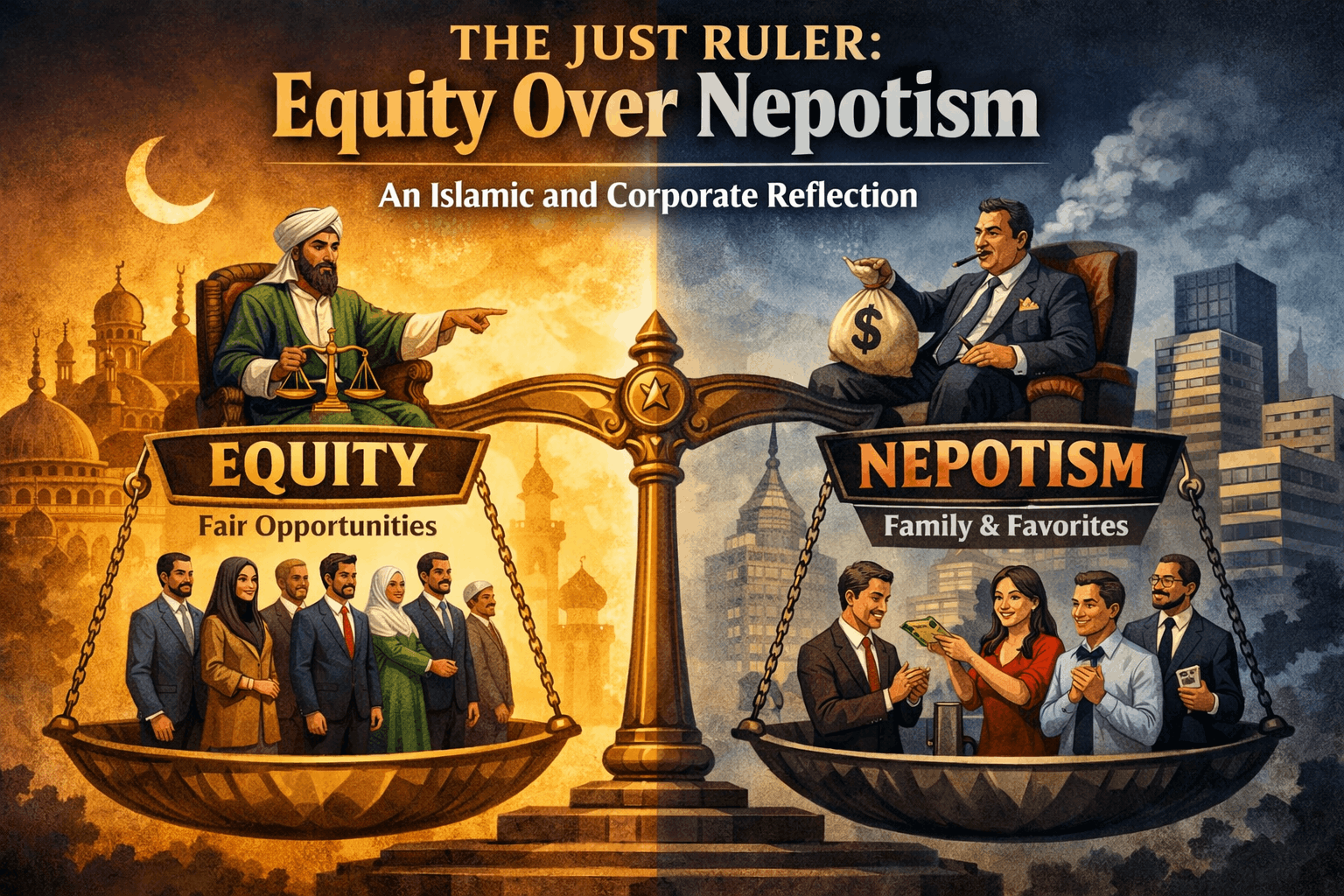
There are moments in leadership when justice is tested not by how we treat strangers, but by how we treat those closest to us. It is easy to speak of fairness when no personal interest is involved. It is much harder when the person being judged is a friend, a relative, a loyal employee, a senior executive, a high performer, or someone who once stood by us. The true measure of a just ruler is not found in speeches, policies, or slogans; it is found in decisions made when favouritism would be convenient, and justice would be costly.
Islamic tradition places justice at the heart of leadership. The Qur’an does not present justice as a decorative virtue but as a binding responsibility. In Surah An-Nisa, believers are commanded to stand firmly for justice, even if it is against themselves, their parents, or close relatives. The verse removes every excuse that human beings normally use to soften judgment: family ties, emotional loyalty, social pressure, wealth, poverty, sympathy, or personal gain. Justice must not bend because the person before us is powerful, beloved, vulnerable, or connected.
This principle is equally clear in Surah Al-Ma’idah, where the Qur’an warns believers not to let hatred of a people lead them into injustice. “Be just,” the verse says, “that is closer to righteousness.” This is a profound ethical standard. Justice is not only required toward those we love; it is also required toward those we dislike. A just ruler does not reward allies unfairly, nor does he punish opponents unjustly. He rises above both affection and resentment.
This is where the idea of “The Just Ruler” becomes deeply relevant, not only in the Islamic tradition but also in the corporate world today. Every manager, HR professional, CEO, board member, department head, and team leader exercises a form of rule. They may not sit on a throne, but they make decisions that affect livelihoods, dignity, opportunity, reputation, and belonging. They decide who is hired, who is promoted, who is disciplined, who is heard, who is ignored, and who is protected. In that sense, leadership is always a moral trust.
The Prophet Muhammad (SAW) expressed this responsibility through the image of a shepherd. In Sahih Muslim, he said that every person is a shepherd and every person is responsible for their flock; the leader is responsible for those under his authority. This metaphor is powerful for modern leadership. A shepherd does not own the flock for personal exploitation. He guards it, guides it, protects the weak, prevents harm, and is answerable for neglect. In HR language, this is stewardship. In Islamic language, it is amanah: a trust.
One of the most striking examples of justice over nepotism is found in the well-known narration involving a woman from Banu Makhzum who had committed theft. Some people attempted to intercede on her behalf because of her noble status. The Prophet ? rejected this attempt to create one rule for the powerful and another for the ordinary. He declared that previous nations were destroyed because they punished the weak while sparing the elite; he then said that even if Fatimah, his own daughter, had committed theft, the law would apply.
The lesson is not merely about punishment. It is about institutional integrity. The Prophet ? was dismantling selective accountability. He was teaching that systems collapse when rules are written for everyone but enforced only on the powerless. This is the disease of nepotism: it hides behind relationship, status, loyalty, tribe, class, and influence. It whispers, “This person is different.” It says, “Let us make an exception.” It asks, “Why damage someone important?” But every unjust exception damages the moral architecture of the whole community.
In the corporate world, nepotism rarely announces itself openly. It often appears in polite, professional language. “He understands our culture.” “She is known to the leadership team.” “He has been loyal for years.” “She is someone we can trust.” “This role requires a familiar person.” None of these statements is automatically wrong. Trust, culture fit, loyalty, and familiarity can matter. But they become dangerous when they replace merit, evidence, transparency, and fair process.
As someone writing from an HR perspective, one can say that the most difficult cases are rarely the ones involving clear incompetence or obvious misconduct. The difficult cases are those where relationships cloud judgment. A senior manager wants to hire a cousin. A board member recommends a family friend. A high-performing employee behaves badly, but leaders hesitate to act because the employee “brings in revenue.” A long-serving manager is promoted despite repeated complaints from subordinates. A charismatic executive escapes the consequences that would have fallen heavily on a junior employee. These are the modern tests of the just ruler.
In HR, equity begins with the design of systems. Good intentions are not enough. A leader may sincerely believe he is fair while still making biased decisions. Islamic justice is not sentimental; it is disciplined. The Qur’anic command to stand firmly for justice suggests effort, structure, and moral stamina. In corporate practice, this means having clear hiring criteria, documented interview processes, diverse selection panels, transparent promotion frameworks, salary bands, grievance mechanisms, and consistent disciplinary procedures.
Consider recruitment. A company says it wants the best talent, but vacancies are quietly filled through personal networks. Relatives of senior staff are shortlisted quickly. Internal referrals receive warm treatment. Candidates without connections face stricter scrutiny. Over time, the company becomes socially narrow. It may still have qualified people, but opportunity is no longer equally accessible. The injustice is not always that an unqualified person was hired; sometimes the injustice is that equally or more qualified people were never given a fair chance.
Islamic ethics would ask: Was the role treated as an amanah? Was the appointment made in the best interest of the organisation and its stakeholders, or to satisfy a personal obligation? Was the process honest? Were all candidates judged by the same standard? The Qur’anic warning against following personal desire in matters of justice is directly relevant here. Personal desire is not always greed. Sometimes it is affection. Sometimes it is discomfort. Sometimes it is the wish to avoid conflict. Sometimes it is loyalty to one’s own circle.
Promotion decisions offer another rich example. In many organisations, people are promoted not because they are ready to lead, but because they are visible to power. They attend the right meetings, speak the language of senior leadership, and build relationships upward. Meanwhile, quieter employees who carry the burden of execution are overlooked. This creates a corporate aristocracy: those near the throne rise faster than those who simply serve well.
A just HR system asks different questions. What evidence supports this promotion? What outcomes has the person delivered? How do they treat their team? Do they develop others or merely manage impressions? Have we considered all eligible candidates? Is the promotion based on capability or closeness? In Islamic terms, the question is whether the decision reflects adl, justice, and ihsan, excellence, or whether it reflects hawa, personal inclination.
Performance management is another area where the just ruler is tested. Many companies claim to value accountability, yet accountability is often uneven. A junior employee who misses a deadline receives a warning. A senior leader who creates a toxic culture receives executive coaching. A frontline worker is penalised for policy violations. A revenue-generating manager is quietly protected. The organisation then wonders why employees lose trust.
Employees are extremely perceptive. They may not know every confidential detail, but they can sense inconsistency. When they see one rule for the influential and another for everyone else, cynicism spreads. Engagement declines. People stop believing in value statements. They may still comply outwardly, but inwardly they withdraw. In Islamic language, injustice does not merely harm the victim; it corrupts the moral climate of the whole community.
A just ruler understands that fairness must be visible enough to create trust. This does not mean exposing private HR matters, but it does mean demonstrating consistency. If harassment is unacceptable, it must be unacceptable regardless of rank. If attendance matters, it must matter across departments. If conflicts of interest must be declared, senior leaders must declare them first. If ethical conduct is part of performance, then results cannot excuse misconduct.
Compensation is another corporate mirror of justice. Pay inequity is one of the clearest signs of hidden favouritism. Sometimes employees doing similar work are paid differently because one negotiated better, one joined through a personal connection, or one had a sponsor in leadership. Market forces are real, but unchecked discretion can create unfairness. A just organisation regularly reviews pay equity, not only to comply with the law but to honour human dignity.
From an Islamic perspective, compensation is not merely a financial transaction. It is tied to rights, effort, and trust. The employer has power; the employee is often in a position of dependency. Justice requires that this imbalance not be abused. In the corporate world, HR professionals become guardians of this balance. They must ask: Are people being rewarded fairly? Are benefits accessible? Are salary decisions explainable? Are hidden biases affecting women, minorities, expatriates, younger workers, older workers, or those without powerful advocates?
Nepotism also appears in disciplinary decisions. Imagine two employees who commit the same violation. One is related to a senior leader; the other is not. If the first receives a private conversation and the second receives a formal warning, the organisation has taught everyone a lesson: policy is negotiable if you have protection. This is precisely the kind of selective justice the Prophetic example warned against. The earlier nations were not destroyed because they had no rules; they were destroyed because rules were applied selectively to the weak and waived for the powerful.
Modern organisations often invest heavily in compliance, codes of conduct, and values campaigns. Yet employees judge culture less by documents and more by exceptions. Who gets away with what? Who is protected? Who is sacrificed? Who is believed? Who is silenced? The just ruler knows that every exception becomes a precedent. Every unfair promotion teaches people how power works. Every ignored complaint tells employees whose dignity matters. Every biased appointment weakens the organisation’s soul.
This is why HR is not merely administrative work. At its best, HR is a justice function. It is where policy meets people. It is where the organisation’s declared values are tested against real human cases. HR professionals often stand between pressure and principle. They may face requests to “manage” a complaint quietly, adjust a job description for a preferred candidate, soften documentation for a senior person, or speed up a promotion without proper assessment. In these moments, HR has a choice: become an instrument of convenience or a guardian of fairness.
Connecting this to professional experience in HR, one learns that justice requires courage, but also skill. It is not enough to say “this is unfair.” One must build processes that make fairness easier and favouritism harder. For example, structured interviews reduce the influence of personal chemistry. Scoring matrices create evidence. Conflict-of-interest declarations expose hidden relationships. Calibration meetings challenge rating inflation. Grievance procedures give employees a voice. Audit trails protect decisions from manipulation. Independent review panels reduce the power of one person’s preference.
Yet systems alone cannot create justice. A process can be followed mechanically while the spirit of fairness is ignored. This is where Islamic principles add depth. The just ruler is not only accountable to policy but also to Allah. The Qur’an repeatedly connects justice with God-consciousness. In Surah Al-Ma’idah, justice is described as closer to righteousness, reminding us that fairness is not a technical exercise; it is an act of taqwa.
This inner accountability matters greatly in corporate life. Many unjust decisions happen in rooms where no outsider is present. A candidate is dismissed casually. An employee’s reputation is damaged in private. A complaint is minimised. A favoured person is defended before evidence is reviewed. A restructuring is designed to remove an inconvenient voice. A leader may escape legal consequences, but Islamic ethics asks a deeper question: even if no one can prove it, was it just?
The concept of the just ruler is also relevant to diversity and inclusion. In many companies, inclusion is treated as a modern trend, but its moral roots are much older. Islam challenged tribal superiority, arrogance, and inherited privilege. The Qur’anic command to uphold justice even against relatives directly confronts tribalism. In today’s workplace, tribalism may appear as nationality bias, school networks, family business politics, departmental cliques, gender stereotypes, or preference for people who “look like us” and “think like us.”
A just corporate leader expands opportunity beyond the familiar. He or she does not lower standards but widens access. This distinction is important. Equity does not mean ignoring merit; it means ensuring that merit is seen fairly. It means asking whether the process allows different forms of talent to emerge. It means recognising that some employees have sponsors while others have only performance. It means noticing who speaks in meetings, whose ideas are credited, who receives stretch assignments, and who is quietly excluded.
In family-owned businesses, which are common in many Muslim societies, the issue becomes even more delicate. Family involvement is not inherently wrong. Families can build businesses with sacrifice, loyalty, and long-term vision. But when family connection overrides competence, the business suffers. Capable non-family employees disengage because they see a ceiling. Younger family members may be placed in authority before they are prepared. Decision-making becomes emotional. Honest feedback becomes risky. The just ruler in such a setting does not reject family, but he refuses to confuse bloodline with entitlement.
A practical Islamic-corporate approach would be to separate ownership rights from management capability. Family members can be given development pathways, mentoring, and governance education, but appointments should be based on readiness and role requirements. Boards should include independent voices. Performance expectations should apply to family and non-family employees alike. This is not anti-family; it is pro-amanah. It protects the business, the employees, and even the family itself from the consequences of unfair privilege.
Another powerful example is succession planning. In unjust organisations, succession is a private arrangement. The chosen successor is informally blessed long before any transparent process begins. Others are made to compete in a race whose winner has already been selected. In a just organisation, succession is treated as a responsibility to the future. Criteria are defined. Potential successors are assessed. Development gaps are addressed. Decisions are documented. People may still be disappointed, but they are less likely to feel deceived.
Justice also requires listening. Many leaders believe they are fair because they do not intend harm. But employees experience justice through voice. Were they heard? Was their explanation considered? Was the investigation impartial? Were they treated with dignity? Procedural justice often matters as much as outcome. In Islamic tradition, judgment requires hearing parties properly, resisting assumptions, and avoiding oppression. In corporate practice, this means fair investigations, confidentiality, evidence-based conclusions, and the right to respond.
The just ruler must also manage compassion wisely. Sometimes leaders confuse justice with harshness, while others confuse compassion with favouritism. Islamic principles hold both together. Justice does not mean cruelty. Equity does not mean mechanical punishment. Circumstances matter. Repentance, learning, intent, harm, and proportionality can all be considered. But compassion must not become selective mercy for the powerful. True mercy is principled, not preferential.
For example, an employee who makes a first mistake may deserve coaching rather than punishment. Another who commits serious misconduct may require firm action. The issue is not whether mercy is shown; the issue is whether similar cases receive similar consideration. A compassionate system can still be just if its compassion is guided by clear principles rather than personal relationships.
The corporate world today urgently needs this model of leadership. We live in an age of sophisticated policies but fragile trust. Employees are more informed, more vocal, and less willing to accept hypocrisy. They expect transparency, fairness, inclusion, and accountability. Organisations that ignore these expectations may retain people physically while losing them emotionally. Talent does not thrive where favouritism rules. Innovation does not flourish where only insiders are heard. Ethical cultures do not grow where leaders protect their own.
The just ruler offers a timeless alternative. He understands that authority is not ownership. She understands that leadership is not a privilege. They understand that every decision leaves a moral footprint. The just ruler does not ask, “How can I protect my circle?” but “What is right?” Not “Who is close to me?” but “Who is most deserving?” Not “What can I get away with?” but “What will I answer for?”
For HR professionals, this is both a challenge and a calling. HR must be more than policy administration. It must help organisations build fair systems, challenge biased decisions, protect employee dignity, and remind leaders of their responsibilities. This requires diplomacy, courage, evidence, and moral clarity. There will be times when HR must speak uncomfortable truths. There will be times when fairness is unpopular. There will be times when standing for justice may affect one’s own career. But that is precisely why the Qur’anic command is so powerful: stand firm for justice, even against yourself and those close to you.
In the end, the just ruler is not a figure locked in history. He appears wherever power is exercised with conscience. She appears in the manager who refuses to hire an unqualified relative. The HR leader who insists on investigating a complaint against a senior executive. The CEO who publishes clear promotion criteria. In the board that separates friendship from fiduciary duty. In the family business owner who tells his son, “You must earn this role.” The team leader who gives credit to the quiet contributor rather than the loud favourite.
Justice is not always dramatic. Often it is administrative, procedural, and quiet. It is found in scoring sheets, salary reviews, interview notes, investigation records, promotion panels, and courageous conversations. But behind these ordinary tools lies a sacred principle: people must not be wronged because they lack power, and people must not be favoured because they possess proximity.
A business that chooses equity over nepotism does more than improve governance. It builds trust. It releases talent. It strengthens culture. It protects leaders from arrogance. It aligns worldly practice with spiritual accountability. And perhaps most importantly, it reminds us that every office, boardroom, classroom, department, and institution is a place where justice can either be upheld or betrayed.
The just ruler, then, is not merely the one who judges others. The just ruler is the one who first judges his own desires, loyalties, fears, and biases. Only then can he lead with fairness. Only then can leadership become amanah. And only then can policy become more than paperwork: it becomes a living expression of justice.
More from this Author
Latest posts


Writers Panel | A Simple Thought | Obituaries | Ziarat Ashura | Islamic Calendar | Facebook | Instagram