

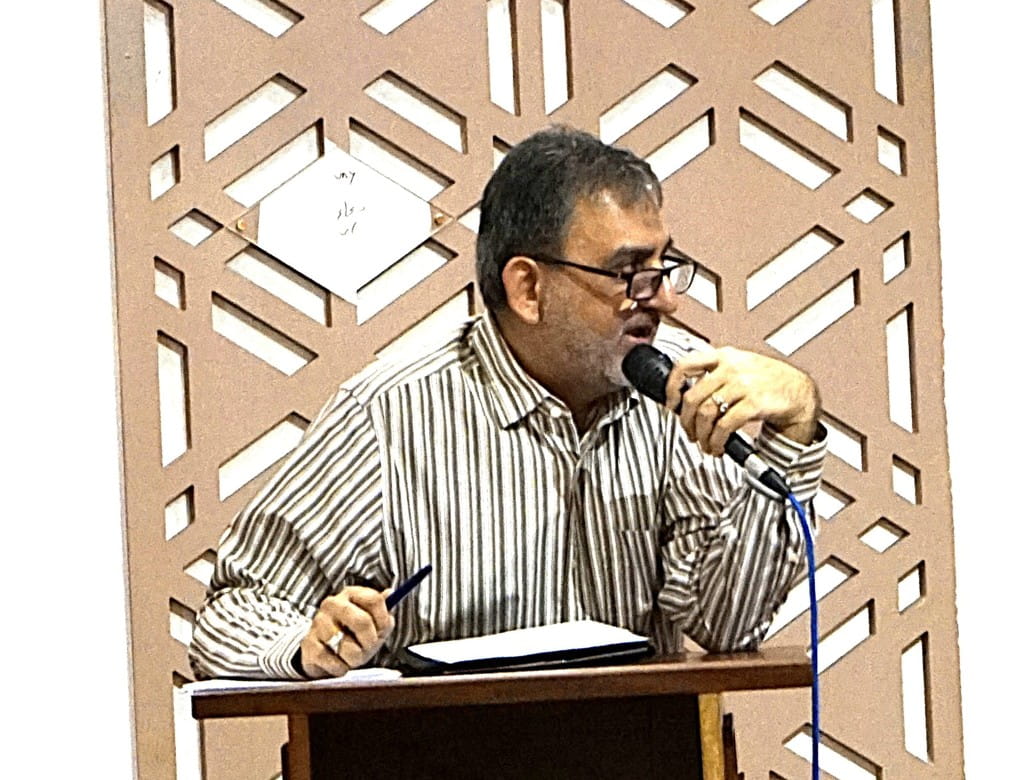
A digital marketing specialist and an Educator-cum-Trainer, he has been involved in community organisations and matters from a young age, and through his writings, continues to speak of social and cultural reform to this day.
His community service began in his youth, when he pioneered the Brain of the Madrasah Quizzes in Dar es Salaam and Nairobi, co-founded and chaired the Debating Society, edited Knowledge Magazine, and served as a Public Speaking trainer. In his middle years, he took on the roles of Secretary of the AFED Tabligh Committee, Secretary of the Haydari Madrasah, Secretary of the Nairobi Jamaat, and member of the Education Board. More recently, he has served as a member of the SSC Committee, Federation Samachar Editor, and member of the CRC.
He is also the founding moderator of this forum (1996).

Addressing Modern Challenges with Prophetic Wisdom
A few months ago, I found myself staring blankly at a glowing monitor. My browser had dozens of open tabs -ranging from ethics papers on generative artificial intelligence to sensationalised news feeds – while my smartphone buzzed continuously with social media algorithmic pushes. I was flooded with information, yet I felt entirely starved of actual comprehension.
In our modern hyper-connected era, we suffer from what sociologist Manuel Castells famously analysed as the structural friction of the Network Society – a socio-technical paradigm where the sheer speed and volume of information flows outpace human cognitive and emotional integration.
We live amidst an infodemic, an overwhelming deluge of facts, opinions, and noise that leaves minds fragmented, attention spans depleted, and souls exhausted. Sitting in that dim light, a stark realisation struck me: our post-industrial, techno-centric generation possesses unprecedented access to human data, yet we are drowning in deep epistemological anxiety.
To bridge this profound chasm, we must re-anchor ourselves in a transformative, holistic paradigm: reviving the Prophetic pursuit of knowledge.
1. The Epistemological Crisis of the Digital Age
The core crisis of our contemporary digital age is not a scarcity of raw data, but the systemic erosion of epistemic humility, intellectual intentionality, and moral purpose. As philosopher Byung-Chul Han observes in his critiques of digital culture, modern society has transitioned from a culture of narrative meaning (Sinn) to a culture of hyper-information (Information), where isolated facts are consumed rapidly without leading to genuine wisdom or existential depth.
We gather data instrumentally – to win ideological debates, optimise personal branding, or secure economic leverage – treating knowledge purely as a transactional commodity.
In stark contrast, the Islamic epistemological tradition understands knowledge (‘ilm) not as a passive collection of facts, but as a transformative light (nur) designed to rectify the human ego (nafs), refine moral character (akhlaq), and restore harmony to society.
The foundational moment of Islamic revelation establishes this holistic epistemological foundation. The very first word conveyed to Prophet Muhammad (SAW) in the solitude of Mount Hira’s cave was a direct imperative:
“Read! In the name of your Lord who created – created man from a clinging clot. Read! And your Lord is the Most Generous, who taught by the pen, taught man that which he knew not.”
– Surah Al-‘Alaq (96:1-5)
In his monumental 20-volume commentary Al-Mizan fi Tafsir al-Qur’an, Allamah Muhammad Husayn Tabataba’i emphasises that the divine command “Read” (Iqra’) is immediately bound to the qualitative condition “in the name of your Lord” (bismi Rabbika).
When empirical inquiry or philosophical discourse is severed from moral responsibility, knowledge degenerates into an instrument of domination or existential nihilism, a dynamic thoroughly dissected by Frankfurt School theorists Max Horkheimer and Theodor Adorno in their critique of instrumental reason.
2. ‘Ilm Naafi’: The Prophetic Distinction Between Data and Wisdom
Classical Muslim epistemologists, most notably Imam Abu Hamid al-Ghazali in his masterwork Ihya’ ‘Ulum al-Din (The Revival of the Religious Sciences), meticulously categorised knowledge based on its teleological outcome. Al-Ghazali differentiated between knowledge that merely satisfies intellectual curiosity or serves worldly vanity, and ‘ilm naafi’ – beneficial knowledge that purifies the heart and impels ethical action.
This scholarly distinction directly mirrors the explicit warnings and supplications of Prophet Muhammad (SAW), who sought divine protection against intellectual hyper-consumption detached from spiritual utility. The Prophetic model demands an ongoing audit of our mental diet. In an age dominated by doomscrolling, attention-economy algorithms, and cognitive fatigue, the prayer for beneficial knowledge serves as a vital psychological and spiritual boundary.
3. Practical Framework: Applying Prophetic Epistemology Today
To revive the Prophetic pursuit of knowledge within contemporary professional and academic spheres, we must systematically replace toxic digital consumption patterns with intentional, value-centred habits.
Ameer al-Mu’minin Imam Ali (AS), in the sermons and sayings compiled in Nahj al-Balagha, drew this same distinction centuries earlier, teaching that if knowledge does not bring a positive change, then it is merely information, and warning that a scholar who fails to act on what he knows gains no more from it than an ignorant man gains from his ignorance.
– Nahj al-Balagha, “On Obtaining True Knowledge”
The Prophet (SAW), as narrated by Imam Ja’far al-Sadiq (AS), taught that whoever treads a path seeking knowledge, All?h makes him tread a path to heaven, and the angels lay down their wings for the seeker of knowledge, being pleased with him.
– Al-Kafi, Kitab Fadl al-‘Ilm (narrated from Imam as-Sadiq, (AS)
4. Reclaiming Purpose in an Age of Noise
Our modern intellectual crisis is fundamentally an existential crisis of teleology and purpose. As sociologist Max Weber famously diagnosed, modern secularisation brought about the “disenchantment of the world” (Entzauberung), stripping human inquiry of ultimate meaning and reducing education to technical efficiency.
We do not suffer from a shortage of data processing power; we suffer from a poverty of wisdom. We do not need more predatory algorithms nudging us toward rage-bait and cognitive scatter. What we urgently require is a deliberate return to a Prophetic Epistemology – a framework where intellect and heart, empirical observation and divine revelation, technical skill and moral integrity exist in a harmonised equilibrium.
By reclaiming knowledge as a sacred trust (amanah) rather than a tool for ego inflation, we can transform our fractured digital lives into spaces of clarity, deep ethical action, and spiritual peace.
Recent posts
- True self-development
 True self-development by Asgar Jafferali Dhanji While physical growth is easy to see, your mind, character, and professional capability evolve in ways that are much harder to gauge. If you look back five years, you are likely not the same person you were then. You are constantly evolving, but reaching the next level of your personal development requires conscious, deliberate action.
 - Adl
 Adl by Sheikh Fattah The concept of justice (‘Adl) occupies a foundational position in Islamic theology and ethics, serving as a lens through which the relationship between the Creator and creation is understood. In his insightful essay, “Adl – Justice and Decree,” originally published in the spring 1984 issue of the journal Nuradeen, Sheikh Fattah provides a concise yet profound exploration of this multi-faceted principle. Drawing extensively from the Holy Quran and the narrative traditions (ahadith) of the Ahlul Bayt – specifically Imam Ali and Imam Ja’far as-Sadiq—the author dismantles the complexities surrounding divine decree, free will, individual morality, and structural social justice. The text functions not merely as an academic exposition of theological doctrine, but as an ethical manifesto that bridges metaphysical truths with practical human responsibility.
 - Eternal Life
 Eternal Life by Ayatullah Murtadha Mutahhari Ayatullah Murtadha Mutahhari’s Eternal Life is a concise but profound exploration of one of Islam’s central beliefs: that human life does not end with death. Drawing on the Qur’an, hadith, Islamic philosophy, and rational argument, Motahhari presents the Hereafter not as a distant abstraction but as the destination that gives meaning to every thought, choice, and action in this world. The book is especially valuable for readers seeking a clear, reasoned introduction to Islamic teachings on death, the soul, barzakh, resurrection, and eternal life.


