

A digital marketing specialist and an Educator-cum-Trainer, he has been involved in community organisations and matters from a young age, and through his writings, continues to speak of social and cultural reform to this day.
His community service began in his youth, when he pioneered the Brain of the Madrasah Quizzes in Dar es Salaam and Nairobi, co-founded and chaired the Debating Society, edited Knowledge Magazine, and served as a Public Speaking trainer. In his middle years, he took on the roles of Secretary of the AFED Tabligh Committee, Secretary of the Haydari Madrasah, Secretary of the Nairobi Jamaat, and member of the Education Board. More recently, he has served as a member of the SSC Committee, Federation Samachar Editor, and member of the CRC.
He is also the founding moderator of this forum (1996).
Safar al-Aakhirah – The Soul’s Journey to the Hereafter

Jahannam (Hellfire) is one of the fundamental realities of the Hereafter in Islamic belief. It is the place of punishment that Allah (SWT) has warned humanity about through the Holy Qur’an and the teachings of Prophet Muhammad (SAWW) and his Ahl al-Bayt (AS). Its descriptions serve as a reminder that our actions in this temporary world have consequences and that every human being will ultimately be accountable to Allah.
Islam teaches that worldly life is a test, and the Hereafter is our final destination. Understanding Jahannam is therefore not simply about learning about punishment; it is about recognising the importance of faith, responsibility, good character and obedience to Allah. These warnings encourage believers to reflect upon their actions and prepare themselves for the journey ahead.
The Holy Qur’an describes Jahannam as having seven gates. Allah (SWT) states in Surah Al-Hijr (15:43–44): “Indeed, Hell is the promised place for them all. It has seven gates; for every gate there is an allotted portion of them.”
This verse establishes the existence of seven gates, through which different groups of people will enter according to Allah’s judgement. Islamic narrations, particularly those reported from the Ahl al-Bayt (AS), provide further explanations of these seven divisions as distinct levels of Hell, each with specific characteristics and descriptions.
According to a report transmitted by Abu al-Jarud from Imam Muhammad al-Baqir (AS), recorded in Tafsir al-Burhan, Allah has made Jahannam into seven levels. The narration associates each level with particular Qur’anic descriptions. It is important to note that the report introduces this explanation with the words “It has reached me, and Allah knows best”, so it should be presented as a reported interpretation rather than an undisputed classification.
The first level is Al-Jaheem, described in the narration as the uppermost level. Its inhabitants are described as standing upon a rocky place within it, where the punishment is extremely severe. Their brains are described as boiling like the contents of pots.
The Qur’an mentions Al-Jaheem in Surah At-Takathur (102:6):
“You will surely see the Hellfire.”
This reminds us that the reality of the Hereafter should never be taken lightly.
The second level is Al-Lazaa, meaning the blazing flame. Its description is connected to Surah Al-Ma’arij (70:15–18), which describes a Fire that calls those who turned away from the truth, rejected guidance and accumulated wealth without fulfilling their responsibilities. This serves as a warning against greed, selfishness and becoming so attached to worldly possessions that we forget our duties towards Allah and other people.
The third level is Saqar. In Surah Al-Muddaththir (74:26–30), Allah (SWT) describes Saqar as a severe punishment, mentioning that it neither leaves nor spares and that nineteen angels are appointed over it. The following verses (74:42–47) explain the actions of its inhabitants. When questioned about what brought them there, they acknowledge that they were not among those who prayed, did not feed the needy, engaged in false discussions and denied the Day of Judgement. This is a particularly important warning because it connects accountability with both our relationship with Allah and our treatment of other people.
The fourth level is Al-Hutamah, meaning the crushing Fire. Its description is connected to Surah Al-Humazah (104:4–9), which warns against mocking others, backbiting, slandering and excessive attachment to wealth. The narration also connects its description with Surah Al-Mursalat (77:32–33), which describes sparks rising like enormous structures and resembling yellow camels. The narration explains that those punished there are repeatedly restored after the punishment, rather than escaping through death. This highlights the seriousness of humiliating others, spreading rumours and believing that wealth makes a person superior.
The fifth level is Al-Hawiyah, described in the narration as a place where Malik, the keeper of Hell, is present. Its inhabitants call upon Malik for relief, but the punishment continues. The narration describes a severely harmful drink being given to them. This can be understood alongside Surah Al-Kahf (18:29), where Allah describes the drink of the people of Hell as water like molten copper that scorches their faces. The narration further describes a punishment in which the inhabitants’ skins are repeatedly renewed.
Allah (SWT) explains this in Surah An-Nisa (4:56):
“As for those who disbelieve in Our communications, We shall make them enter fire; so oft as their skins are thoroughly burned, We will change them for other skins, that they may taste the chastisement; surely Allah is Mighty, Wise.”
The sixth level is Al-Sa’eer, meaning the blazing inferno. The narration describes it as containing numerous canopies, castles and houses of Fire, with different forms of punishment within them. It also mentions chains and shackles.
The Qur’an refers to Al-Sa’eer in Surah Al-Insan (76:4):
“Surely We have prepared for the disbelievers chains and shackles and a blazing Fire.”
This description reminds us of the seriousness of rejecting divine guidance and the consequences of persistent wrongdoing.
The seventh level is Jahannam, described in this narration as the final and deepest level. Within it, the narration mentions several particularly severe places of punishment. One is Al-Falaq, described as a pit that, when opened, causes the Fire to blaze intensely. Another is Sa’ud, described as a mountain of brass made from Fire. The narration also mentions Atham, a valley of molten brass flowing around the mountains. These particular descriptions come from the narration and should not be confused with direct descriptions in the Qur’an. Although Surah Al-Falaq (113:1) contains the name Al-Falaq, its connection to a pit within Jahannam is specifically from the reported narration, not the direct meaning of the Qur’anic verse.
These descriptions help us understand the seriousness of Jahannam, but we should not claim that every individual is assigned to a particular level based simply on one sin. Allah alone knows each person’s complete circumstances, intentions, knowledge and repentance, and His judgement is perfectly just.
The Qur’an provides several other descriptions of the severity of Jahannam. In Surah Al-Mulk (67:6–11), the people of Hell express regret and acknowledge that they failed to listen to the warnings and use their understanding. This highlights the importance of reflecting upon the truth while we still have the opportunity to change our lives. The punishment of Jahannam is also described in Surah An-Nisa (4:56), reminding humanity that Allah’s judgement is just and that nobody can escape His knowledge.
The Ahl al-Bayt (AS) repeatedly reminded their followers about the consequences of wrongdoing and the importance of preparing for the Hereafter. Imam Ali (AS), in Nahj al-Balagha, warns humanity about the intensity of the Fire and the seriousness of its punishment. His teachings encourage believers not to become careless about their actions or assume that worldly life will continue forever. He also reminds us that the opportunity to repent and perform good deeds exists during our lifetime, making it important not to delay correcting our mistakes.
Imam Ja’far al-Sadiq (AS) also teaches the importance of balancing fear and hope. In a narration recorded in Al-Kafi, the Imam explains that a believer should fear Allah’s punishment while maintaining hope in His mercy. This is an essential part of Islamic spirituality. A believer should neither become so comfortable with their actions that they forget accountability nor become so overwhelmed by fear that they lose hope in Allah’s forgiveness.
Islam warns against numerous actions that can lead a person towards punishment, including shirk (associating partners with Allah), kibr (arrogance), zulm (oppression), hypocrisy, backbiting, and deliberately neglecting religious obligations. These behaviours damage both our relationship with Allah and our relationship with other people. In particular, Islam places great importance on respecting the rights of others, because worship alone does not excuse injustice or mistreatment.
Despite the serious warnings about Jahannam, Islam places equal importance on Allah’s infinite mercy.
In Surah Az-Zumar (39:53), Allah (SWT) says:
“Do not despair of the mercy of Allah. Indeed, Allah forgives all sins.”
This verse encourages those who have made mistakes to sincerely return to Allah through Tawbah (repentance). A believer should continuously seek forgiveness, fulfil their wajibaat, avoid wrongdoing and strive to improve their character.
From the Shia perspective, love and loyalty towards Prophet Muhammad (SAWW) and his Ahl al-Bayt (AS) are central to our faith. However, this love must be reflected through our actions. Following their teachings means practising justice, humility, honesty and obedience to Allah. The belief in Shafa’ah (intercession) of the Ahl al-Bayt (AS) is also an important aspect of Shia belief, but it should never be treated as permission to commit sins or neglect our responsibilities. Rather, their example should inspire us to become better believers and prepare ourselves for the Hereafter.
Ultimately, the descriptions of Jahannam are powerful warnings intended to guide humanity towards righteousness. They remind us that this world is temporary, that our choices matter and that we must take responsibility for our actions. As followers of the Ahl al-Bayt (AS), we should strive to live with sincerity, humility, justice and obedience to Allah, while constantly seeking His forgiveness and mercy.
May Allah (SWT) protect us from the punishment of Jahannam, forgive our shortcomings and grant us Jannatul Firdaus through the intercession of Prophet Muhammad (SAWW) and his purified Ahl al-Bayt (AS). Ameen.
Recent posts
- Beyond the Stars
 Beyond the Stars by Mahershah Yawerabbas Mahershah Jahannam (Hellfire) is one of the fundamental realities of the Hereafter in Islamic belief. It is the place of punishment that Allah (SWT) has warned humanity about through the Holy Qur’an and the teachings of Prophet Muhammad (SAWW) and his Ahl al-Bayt (AS). Its descriptions serve as a reminder that our actions in this temporary world have consequences and that every human being will ultimately be accountable to Allah.
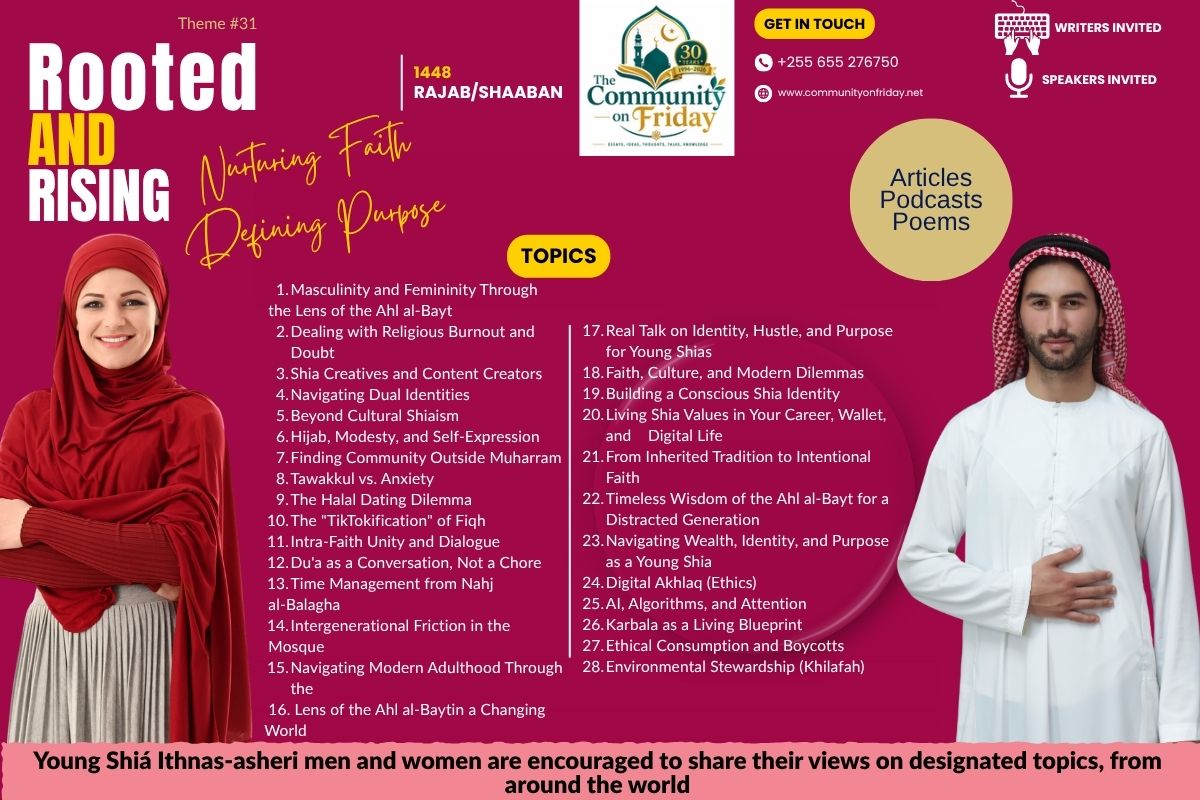
- Theme #31: Rooted and Rising
 Theme #30: Beyond the Stars
- Life in the Barzakh
 Life in the Barzakh by Mohamedarif Suleman In Shi’i theology, death is not annihilation but transition. The soul leaves the body and enters the Barzakh, an intermediate realm between worldly life and Resurrection. The Qur’an uses barzakh only three times, but only in 23:100 does it carry this meaning: “behind them is a barrier until the Day they are resurrected” 1.


