
The writer was born and raised in Kenya and moved to the UK in 1972 for higher studies before settling in the USA in 1980. He began serving the Muslim community of Allentown, Pennsylvania, in 1985, holding leadership roles including Program Organiser, Secretary, Assistant Treasurer, and Vice President. In 1996, he was elected President of the SIJPA, where he led the building of the Al-Ahad Islamic Centre.
A committed advocate for social justice and interfaith harmony, he serves on the boards of the Lehigh Valley Justice Institute, the Lehigh Conference of Churches, the Interfaith Action Committee, End Mass Incarceration, and Imamia Medics International, and is Vice Chair of the Lehigh Valley ACLU. He is also active in local election campaigns.
He writes on social justice through his blog and in national and global newspapers, and is the author of Inspirational Insight. He is married and a father of two boys and two girls.
Prophet Muhammad Day
The Noble Prophet – by the resident alim Syed Rizwan Rivi.
When speaking about Prophet Muhammad (SAW) in English, we commonly refer to him as the “Holy Prophet.” This expression has become so familiar that we rarely stop to ask whether it actually reflects the terminology used for him in the Qur’an and Islamic tradition.
A more appropriate expression, I believe, is “the Noble Prophet.”
The reason is simple: in our Islamic vocabulary, the Prophet (SAW) is described as Rasool-e Akram – the Noble, Most Honoured, or Most Generous Messenger.
We do not ordinarily find the title Rasool-e Muqaddas being used for him in our foundational Islamic texts.
The distinction becomes even more meaningful when we consider the history of the word muqaddas in modern Muslim languages.
In Persian and Urdu Christian terminology, muqaddas is commonly used to translate the English word “holy.”
Thus, one encounters expressions such as Holy Gospel/Bible and “Holy Mary. These are well-established Christian expressions for their sacred scripture and revered personalities.
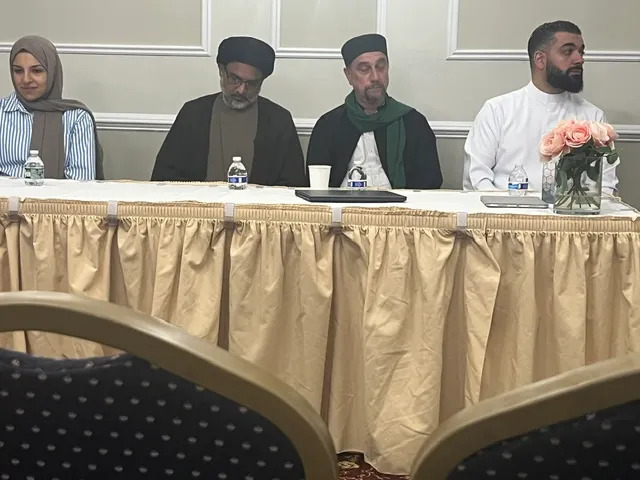
Dr Sami Catovic, Executive Director of NBIC, recounted the story of Jaafar ibn Abi Talib speaking on behalf of the Muslim refugees to the Christian King of Abyssinia about the Prophet Muhammad.
When the early Muslims fled persecution in Mecca and sought refuge in Abyssinia, the Quraysh sent Amr ibn al-Aas and Abdull?h ibn Abi Rabiah to persuade the Negus to return them.
The Negus refused to surrender the Muslims without hearing their side.
Jaafar ibn Abi Taalib spoke on behalf of the Muslim refugees. According to the famous account in the S?rah of Ibn Is?aaq, he described their condition before Islam: they had been a people of ignorance who worshipped idols, ate carrion, committed immoral acts, severed family ties, and mistreated their neighbours.
Then, he said, Allah sent them “a Messenger from among us” whose lineage, truthfulness, trustworthiness, and chastity they knew.
The Messenger called them to worship Allah alone, speak the truth, fulfil trusts, maintain family relations, treat neighbours well, and abandon bloodshed and immorality.
The Negus then asked Jaafar whether he could recite something revealed to their Prophet. Jaafar replied yes and recited from Surat Maryam, describing Mary and the miraculous birth of Jesus.
The Christian king was deeply moved. According to the traditional account, the Negus wept until his beard became wet, and his bishops also wept until their scriptures became wet with their tears.
He then declared that what Muhammad (SAW) had brought and what Jesus had brought came from the same source.
The Quraysh delegation, however, tried once more. They told the Negus that the Muslims held an unacceptable belief concerning Jesus.
The next day the Muslims were summoned again. Jaafar courageously stated their belief:
“We say concerning him what our Prophet (SAW) brought to us: he is the servant of Allah, His messenger, His spirit, and His word which He cast unto Mary, the Virgin, the pure.”
The Negus reportedly picked up a small stick from the ground and said that Jesus, the son of Mary, did not exceed what Ja?far had said by even the measure of that stick. He then granted the Muslims his protection.
Recent posts
- True self-development
 True self-development by Asgar Jafferali Dhanji While physical growth is easy to see, your mind, character, and professional capability evolve in ways that are much harder to gauge. If you look back five years, you are likely not the same person you were then. You are constantly evolving, but reaching the next level of your personal development requires conscious, deliberate action.
 - Adl
 Adl by Sheikh Fattah The concept of justice (‘Adl) occupies a foundational position in Islamic theology and ethics, serving as a lens through which the relationship between the Creator and creation is understood. In his insightful essay, “Adl – Justice and Decree,” originally published in the spring 1984 issue of the journal Nuradeen, Sheikh Fattah provides a concise yet profound exploration of this multi-faceted principle. Drawing extensively from the Holy Quran and the narrative traditions (ahadith) of the Ahlul Bayt – specifically Imam Ali and Imam Ja’far as-Sadiq—the author dismantles the complexities surrounding divine decree, free will, individual morality, and structural social justice. The text functions not merely as an academic exposition of theological doctrine, but as an ethical manifesto that bridges metaphysical truths with practical human responsibility.
 - Eternal Life
 Eternal Life by Ayatullah Murtadha Mutahhari Ayatullah Murtadha Mutahhari’s Eternal Life is a concise but profound exploration of one of Islam’s central beliefs: that human life does not end with death. Drawing on the Qur’an, hadith, Islamic philosophy, and rational argument, Motahhari presents the Hereafter not as a distant abstraction but as the destination that gives meaning to every thought, choice, and action in this world. The book is especially valuable for readers seeking a clear, reasoned introduction to Islamic teachings on death, the soul, barzakh, resurrection, and eternal life.