
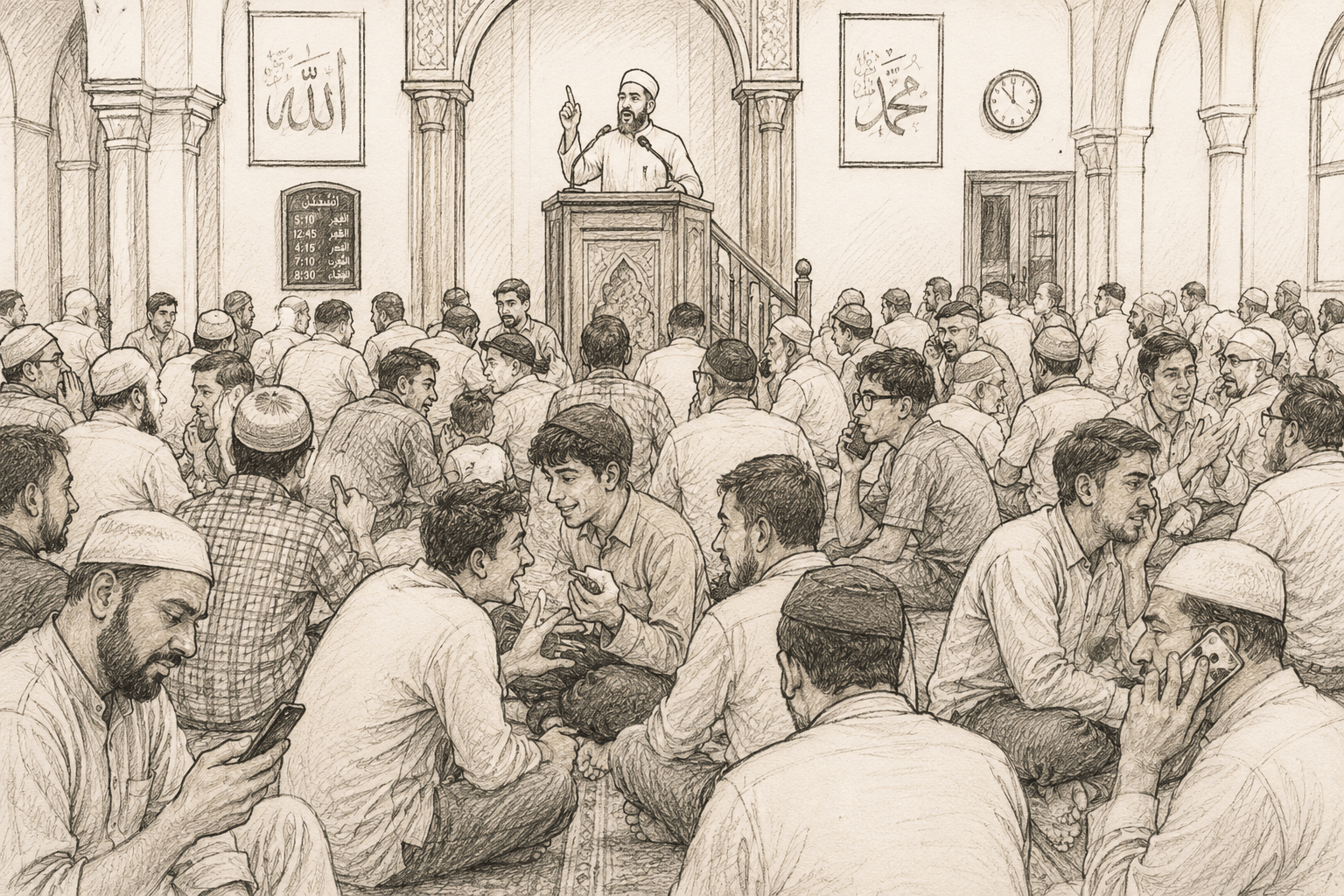
When Places of Worship Lose Their Sacred Silence
Economic Justice & Leadership Accountability
 Mohamedarif Mohamed Suleman (Dar es Salaam, Tanzania) is a digital marketing specialist and an Educator-cum-Trainer. He has involved himself in community organisations and matters from a young age, and through his writings, continues to speak of social and cultural reform to this day. He is also the founding moderator of this forum (1996).
There was a time when entering a place of worship felt like entering another world. The moment one stepped through the doors, the noise of daily life seemed to fade away. The hurried footsteps slowed, voices softened, and hearts turned towards reflection. A mosque was not merely a building where prayers were performed; it was a sanctuary of tranquillity, a space where a person could detach from the distractions of the world and reconnect with the Creator.
ched a point where asking someone not to speak loudly during a sermon or not to allow a phone to ring during prayer is sometimes viewed as excessive rather than as a basic act of consideration.
There is an old saying that “a whisper in one corner can become a storm in another.” What may appear to be a harmless conversation to one person can break the concentration of someone who has come seeking peace, guidance, or a moment of connection.
Throughout history, wise people have understood the power of silence. The great thinkers, spiritual leaders, and scholars often sought solitude because silence creates space for thought. It allows the mind to process, the heart to reflect, and the soul to listen. Noise, on the other hand, constantly demands attention. It pulls people outward when the purpose of worship is often to bring people inward.
Modern thinkers have discussed how noise can become one of the most effective instruments of distraction. The idea is simple: a constant flood of sound prevents deep reflection. When every moment is filled with chatter, alerts, conversations, and interruptions, the human mind struggles to pause and contemplate. Silence invites awareness; noise encourages constant reaction.
This raises a question for our times: are we truly “living in the moment”, or are we constantly living away from the moment?
A person sitting in a mosque while checking a phone, responding to messages, allowing notifications to ring, or engaging in casual conversations may physically be present but spiritually absent. The body is in the place of worship, but the mind is somewhere else.
Islam places great emphasis on respect for sacred spaces. The Qur’an reminds believers:
“Successful indeed are the believers: those who humble themselves in their prayers.” (Qur’an 23:1-2)
Humility in prayer is not only about physical actions; it also involves creating an environment where others can achieve that same state of humility.
There is also the well-known teaching from the life of the Prophet Muhammad (SAW) regarding the importance of not disturbing others during worship. The Prophet ? advised that those who recite Qur’an should not raise their voices in a way that disturbs others who are praying. The principle behind this guidance is timeless: worship is a personal journey, and everyone deserves an atmosphere that supports concentration and devotion.
This culture of distraction is not limited to mosques alone. Even moments of grief and remembrance are affected. At burials, where families gather to bid farewell to loved ones and reflect on the reality of life and death, conversations often continue as though the occasion is a social gathering. Mobile phones ring during solemn moments. People answer calls without hesitation. Children run around making noise, not because children are unwelcome, but because adults have increasingly stopped teaching them the value of respecting certain spaces.
Past generations understood these boundaries. Elders would gently remind children to lower their voices. A person entering a mosque would observe the atmosphere before speaking. A gathering for a funeral would naturally carry an air of dignity and reflection. Respect was not written on signs; it was carried in people’s behaviour.
There is a famous story from Islamic tradition about a man who entered the mosque while people were engaged in worship. He behaved carelessly, and the companions of the Prophet (SAW) wished to correct him harshly. Instead, the Prophet ? responded with patience and wisdom, teaching that guidance should come with understanding. The lesson was not only about correcting mistakes but also about building awareness.
Perhaps the question we must ask ourselves is not only “where are we going?” but “what are we becoming?”
A mosque is not simply a place where people gather; it is a place where hearts are meant to gather. A community is not measured only by the number of people attending prayers, but by the respect people show for each other’s spiritual needs.
The challenge before us is to revive the culture of mindfulness. To understand that silence is not emptiness; it is an opportunity. It is in silence that reflection grows, gratitude develops, and connection strengthens.
The world outside is already filled with noise. The mosque should remain one of the few places where the soul can still hear itself.
The greatest loss would be if, while standing in the house of Allah, we become so surrounded by noise that we forget why we came there in the first place.
Recent posts



Search by date
Writers Panel | A Simple Thought | Obituaries | Ziarat Ashura | Islamic Calendar | Facebook


