
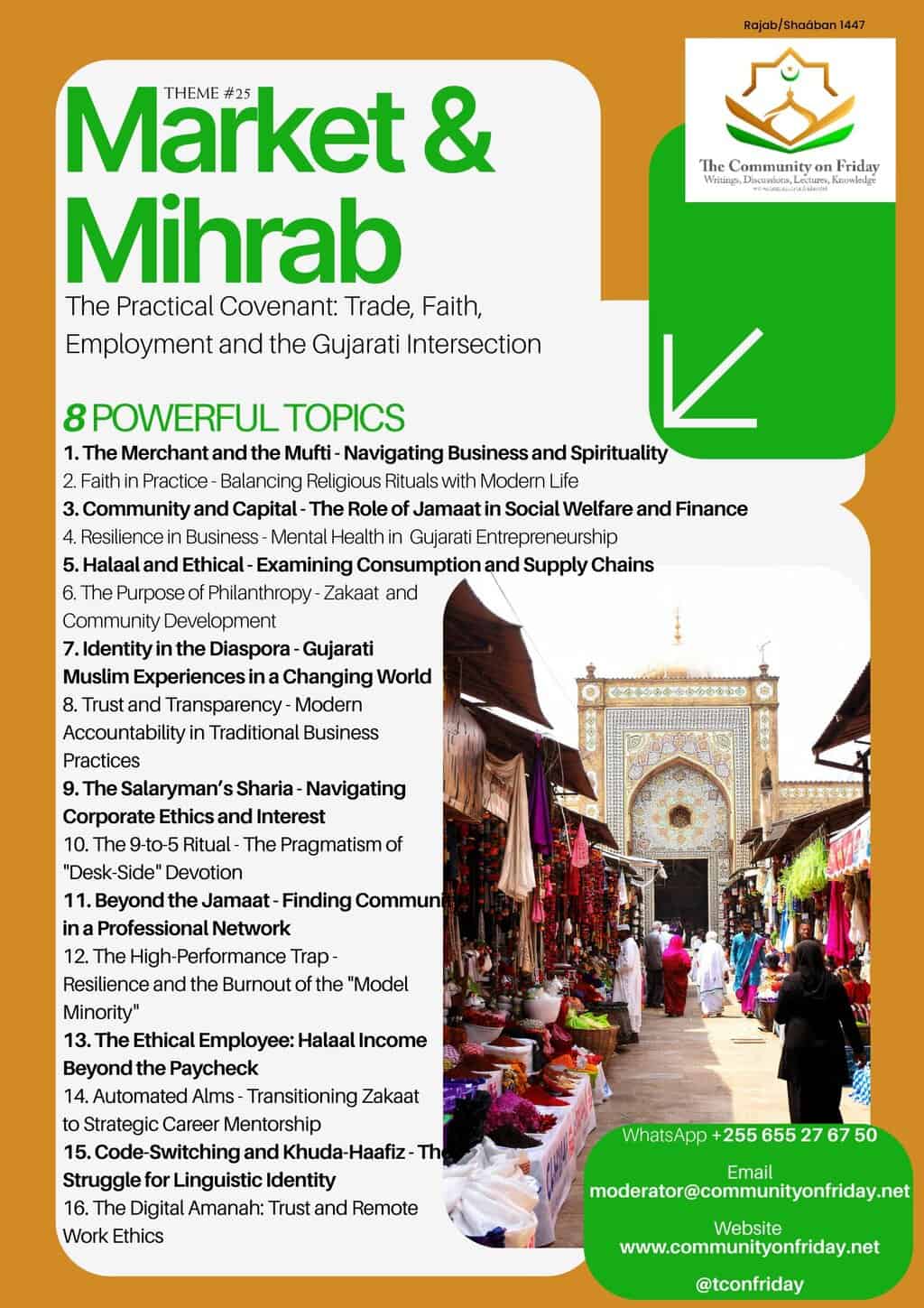
The Practical Covenant: Trade, Faith, Employment and the Gujarati Intersection
We live in a time where the intersections of trade, faith, and community engagement are more relevant than ever. We present Market & Mihrab: The Practical Covenant. This gathering takes a deep dive into the unique relationship between business practices, employment concepts and spiritual principles, particularly within the Gujarati community.
The intent behind this initiative is to explore the harmony that can exist when commerce and spirituality coexist. Through eight powerful topics, we aim to unravel the intricate connections between ethical employment, social responsibility, and community development, all underpinned by a foundation of faith.
As we embark on this journey, we invite participants to engage in meaningful discussions and forge connections that transcend traditional boundaries. We hope that Market & Mihrab will inspire a new generation of leaders who prioritise ethical practices and social welfare in all aspects of their lives.
We look forward to your active participation in this enriching dialogue. Let us come together to cultivate a future where faith and commerce unite for the greater good.
The series will cover the following subtopics
- The Merchant and the Mufti: Navigating Business and Spirituality
Explores the roles of business leaders and religious scholars in guiding ethical practices, emphasising how faith can inform business decisions.- Core Idea: Collaboration between business leaders and religious authorities is essential.
- Expanded Insight: This partnership promotes ethical decision-making, where spiritual values guide commercial practices, fostering an environment where faith and business coexist harmoniously.
- Transparency in Trade: Building Trust
Discusses the importance of transparency in business transactions, highlighting that trust is essential for long-term relationships and community support.- Core Idea: Trustworthy practices are vital for sustainable business relationships.
- Expanded Insight: By prioritising transparency, businesses can build credibility, encouraging customer loyalty and community support, which ultimately leads to long-term success.
- The Community and Capital: The Role of Jamaat in Social Welfare
Examines how community organisations (Jamaats) can leverage resources to support social welfare initiatives, ensuring that economic growth benefits all members.- Core Idea: Community organisations can play a pivotal role in resource distribution for social good.
- Expanded Insight: Jamaats can harness financial resources to implement social welfare programs, ensuring that economic advancements support all community members and uplift the less fortunate.
- Resilience in Business: Mental Health in Ethical Environments
Focuses on the significance of maintaining mental health in the workplace, advocating for environments that promote holistic well-being while upholding ethical standards.- Core Idea: A supportive work environment enhances employee mental health.
- Expanded Insight: Prioritising mental health within organisations not only increases employee well-being and productivity but also aligns with ethical business practices that value human dignity.
- The Purpose of Philanthropy: Zakaat and Community Development
Analyses the role of Zakaat (charity) in empowering communities and fostering economic development, reinforcing the idea that financial success should benefit the wider society.- Core Idea: Charity is a vital tool for community empowerment.
- Expanded Insight: Through Zakaat, businesses can reinvest in their communities, promoting development initiatives that address poverty and inequality, which reinforces the social contract among community members.
- Unity in Diversity: Global Muslim Entrepreneurs
Celebrates the diversity of Muslim business practices around the world, encouraging cross-cultural collaboration and learning opportunities among entrepreneurs.- Core Idea: Diversity among Muslim entrepreneurs fosters innovation and collaboration.
- Expanded Insight: By learning from diverse business practices globally, entrepreneurs can adopt and adapt strategies that enrich their own commercial endeavours and strengthen cross-cultural ties.
- The Bay’ah: Shar??ah and Business Ethics
Investigates how Islamic ethical principles influence business practices, providing a framework for integrity and accountability in commerce.- Core Idea: Islamic ethical principles offer a guiding framework for business conduct.
- Expanded Insight: Adhering to Shar??ah can help businesses ensure accountability, integrity, and fairness in their operations, creating a culture of trust and ethical responsibility.
- The Professional Islamic Model: “Model the Prophet”
Encourages business professionals to emulate the characteristics of the Prophet Muhammad in their dealings – honesty, integrity, and compassion – creating a business model rooted in strong ethics and faith.- Core Idea: Emulating the Prophet Muhammad’s attributes enhances business practices.
- Expanded Insight: By embodying qualities such as honesty, compassion, and justice, professionals not only strengthen their ethical foundations but also inspire others to adopt these values in their commercial interactions.
- The Professional Islamic Model: “Model the Prophet”
Encourages business professionals to emulate the characteristics of the Prophet Muhammad in their dealings – honesty, integrity, and compassion – creating a business model rooted in strong ethics and faith.- Core Idea: Merging tradition with innovation fosters sustainable business practices.
- Expanded Insight: By integrating time-honoured values with cutting-edge technologies, businesses can develop solutions that not only respect cultural heritage but also meet contemporary needs, driving both growth and community relevance.
- Ethical Innovation: Bridging Traditional Practices with Modern Solutions
This topic explores how businesses can blend traditional ethical practices with contemporary innovations. By embracing technology and modern strategies while adhering to core values, entrepreneurs can create sustainable solutions that resonate with both heritage and progress.
– Core Idea: Merging tradition with innovation fosters sustainable business practices.
– Expanded Insight: By integrating time-honoured values with cutting-edge technologies, businesses can develop solutions that not only respect cultural heritage but also meet contemporary needs, driving both growth and community relevance. - Social Entrepreneurship: Business as a Force for Good
Examines the role of social enterprises in addressing societal challenges through profitable business models. This topic highlights how integrating social impact with business goals can lead to innovative solutions that benefit communities while still achieving economic success.
– Core Idea: Business can be leveraged to address social issues effectively.
– Expanded Insight: By prioritising social impact alongside financial returns, social entrepreneurs create innovative business models that tackle societal challenges, demonstrating that profit and purpose can coexist to benefit communities. - Faith-Based Leadership: Influencing Corporate Culture
Discusses how leaders who incorporate their faith into their management style can positively shape corporate culture. This approach promotes ethical behaviour, inclusivity, and compassion within organisations, leading to a more engaged and motivated workforce.
– Core Idea: Leadership that integrates faith shapes a positive work culture.
– Expanded Insight: Leaders who embody their ethical commitments foster workplace environments that promote integrity, compassion, and collaboration, ultimately leading to increased employee satisfaction and improved organisational performance. - Diversity in the Workforce: Embracing Varied Perspectives
Centres on the importance of diversity in promoting creativity and innovation in business. By creating inclusive workplaces that welcome diverse backgrounds and ideas, companies can enhance problem-solving and adapt more effectively to changing markets.
– Core Idea: A diverse workforce enhances creativity and problem-solving.
– Expanded Insight: By cultivating an inclusive environment that values diverse perspectives, businesses can drive innovation and improve decision-making processes, leading to better outcomes and stronger community ties. - Consumer Ethics: Informed Choices and Community Impact
Explores how consumer behaviour and ethical purchasing decisions can influence businesses. This topic emphasises the power of informed consumers in shaping corporate responsibility, encouraging businesses to adopt ethical practices in response to market demands.
– Core Idea: Consumer awareness influences corporate responsibility.
– Expanded Insight: Ethically informed consumers can drive businesses to adopt responsible practices. This collective consumer mindset pressures companies to prioritise transparency and uphold ethical standards, resulting in a positive impact on the community and the environment. - Interfaith Collaboration: Building Bridges through Business
Focuses on the potential for businesses to foster interfaith dialogue and cooperation. By collaborating across religious lines, organisations can work collectively towards shared goals, enhancing community cohesion and understanding.
– Core Idea: Interfaith cooperation fosters community resilience and understanding.
– Expanded Insight: Through collaborative business initiatives, individuals from different faith backgrounds can work together towards common goals, enhancing social cohesion and creating networks that promote interfaith dialogue and mutual respect. - Lifelong Learning: Continuous Development in Ethics and Trade
Highlights the importance of continuous education and professional development in fostering ethical business practices. This topic encourages professionals to engage in lifelong learning to remain adaptable and informed about evolving ethical standards and market dynamics.
– Core Idea: Ongoing education is essential for ethical business practices.
– Expanded Insight: Committing to lifelong learning equips professionals with the knowledge to navigate evolving ethical landscapes and market challenges, promoting adaptability and innovation in their practices while reinforcing their ethical foundations.
Please get in touch for free subscriptions, opportunities to become a panellist, or logo advertising support. Guest writers are also invited to get in touch.
Email moderator@communityonfriday.net | WhatsApp +255 655 276750
We would like to express our sincere gratitude to all the supporters who make the publication and the work of internal propagation possible. Without your generous contributions, we would not be able to share our vision and mission with the world. Your support enables us to produce quality content, reach a wider audience, and inspire positive change in our communities. We appreciate your trust and confidence in our work, and we hope to continue serving you with excellence and integrity. Thank you for being part of our journey and our family.


