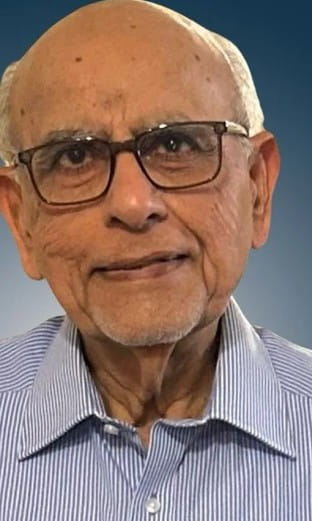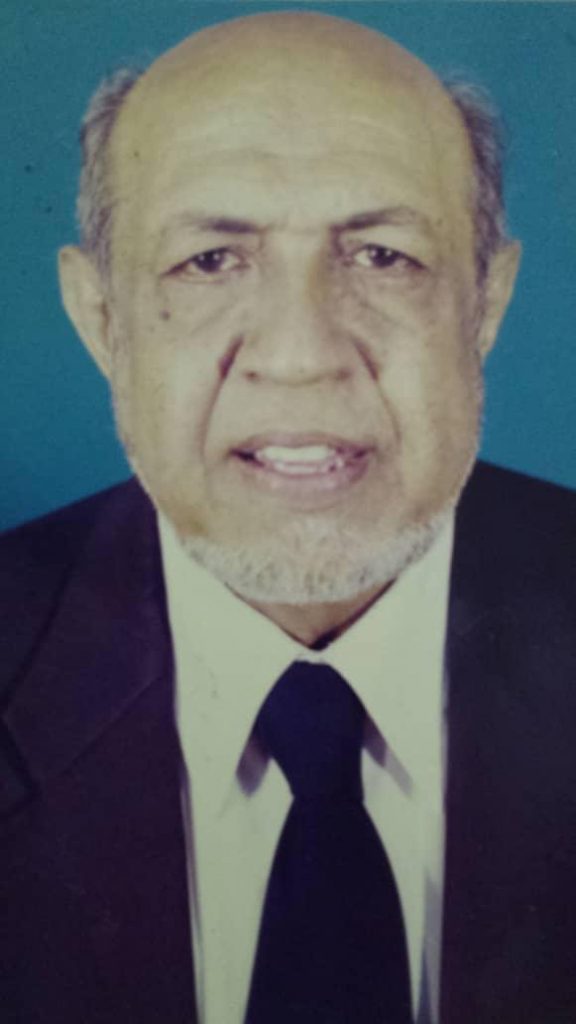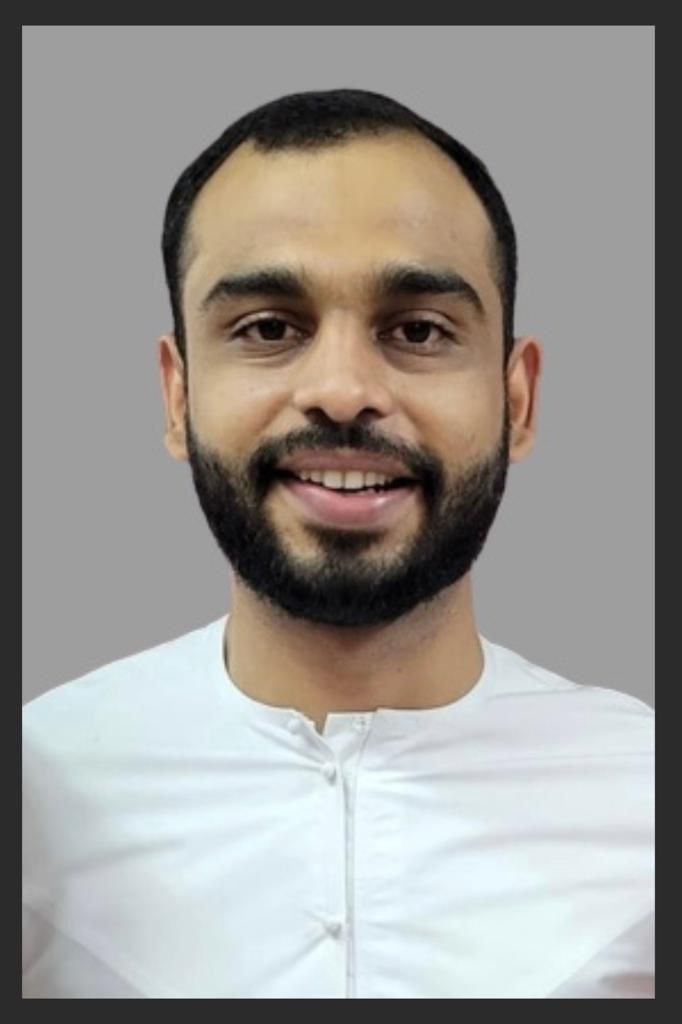
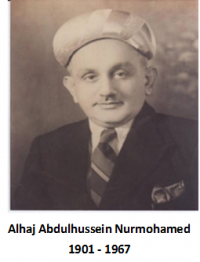
Marhum Abdulhussein Nurmohamed Kalyan
1901-1967
Source: AFED Trade Directory – 1960 and updates by Br. Mustafa Pirmohamed of Orlando, USA, edited by TCoF
Marhum Abdulhussein Nurmohamed Kalyan was born in Zanzibar in 1901, into one of East Africa’s pioneering families. His father, Nurmohamed Kalyan, travelled from India to the Island of Zanzibar in 1880 at age ten, accompanied by his brothers Esmail Kalyan and Sachedina Kalyan. The Kalyan family stands among the first families to settle in East Africa, laying roots that would span generations across the region.
He completed his primary school education in Zanzibar before relocating to Mombasa in 1913 at age twelve. Demonstrating remarkable enterprise and vision, within just two years of arriving in Mombasa, he established the renowned A H Nurmohamed & Co Ltd., a business that would later expand to have several branches throughout East Africa.
Murrabbi Abdulhussein’s journey into leadership began in 1922, and by 1926 he had entered public community service – a commitment that would define the next four decades of his life.
His public service record was extraordinary. He served as an executive member of both the Indian National Congress and the Indian Association for thirteen years before assuming the position of Honorary Secretary in both institutions for two years. His dedication to the Indian community in Mombasa culminated in his appointment as President of the Indian Association, a position he held until 1948.
His contributions extended far beyond community organisations. He was a member of the Mombasa Municipal Board from 1939 to 1955, serving as Vice-President of the Board in 1950–1951. He also served on the Kenya Board of Commerce & Industry for Copra and Coconut Oil production from 1945 to 1948, and as President of the Federation of Chambers of Commerce of Eastern Africa – the highest organ of the East African business community from 1948 to 1950.
After sixteen years of dedicated service in the Municipal Council, Murrabbi Abdulhussein retired due to ill health. Yet his commitment to public life endured. He served as President of the Pandya Memorial Society and as an executive committee member of the Coast Subsidiary Hotel, Kenya Maize Marketing Board, East African Tourist Travel Association, and the Board of Governors of Mombasa Muslim Institute. In 1958, he was appointed as a member of the Kenya Legislative Council, and in 1960, he was appointed to the Kenya Council of State. He also served on the Education Board of Mombasa Jamaat.
Murrabbi Abdulhussein’s record of service to the Khoja Shia Ithna-Asheri community was immense. He served as President of the Federation of Khoja Shia Ithna-Asheri Jamaats of Africa from 1946 to 1949 and again from 1952 to 1958. His efforts to unite the community and advance its progress remain well documented and deeply appreciated.
Owing to his noble and distinguished service, he was awarded honorary membership of the Council. During his first term as President, he initiated several landmark programs: conducting a census of the community, introducing Birth and Marriage Certificates issued by the Council, awarding education grants and scholarships for higher education, obtaining scholars for Tabligh, and securing grants for the acquisition of higher religious education.
Among the many chapters of Murrabbi Abdulhussein’s remarkable life was a journey that reflected his forward-thinking vision and commitment to exposing the next generation to global experiences.
Sultan, the son of Murrabbi Abdulhussein, recounts this remarkable chapter. Murrabbi Abdulhussein approached a senior Khoja Ismaili businessman in Mombasa, Hassanali Mussa Jetha—a man with two sons named Fatheali and Sadru—with a request to take Sultan along to the Trade Fair in Canton, China, believing that this expedition would furnish him with invaluable experiences for the future.
Their journey took them to China during the era when Chairman Mao led the Communist Party, and Zhou Enlai served as Prime Minister. After concluding their participation in the trade fair, they travelled to Beijing (then known as Peking) on October 20, 1964, to celebrate Kenyatta Day at the Kenyan embassy. Henry Mulie, an Oxford graduate, served as ambassador at that time.
The embassy staff, being Muslims, suggested visiting a nearby mosque. During the visit, another notable aspect revealed the enduring existence of Islam in China—even at that time, many hotels in China offered meals tailored for Muslims.
Reflecting on his visit to China, Sultan drew parallels with the formation of the Alibhai Panju Jaffery School in Mombasa. This school, established during colonial times, received grants from the British government, with the exception of the assembly hall construction, which was deemed non-educational. The assembly hall featured a sign above its stage bearing a saying from the Holy Prophet (s.a.w.w.): “It is obligatory on all Muslims, male and female, to seek knowledge.” This sign highlighted the importance of education in the Muslim community – a value that had driven Muslims to seek knowledge even in far-flung places like China centuries ago.
Murrabbi Abdulhussein Nurmohamed Kalyan passed away in Karachi on August 1, 1967, at the age of 66. He is buried at Habib Cemetery.
He was survived by his beloved wife Kulsumbai, daughter of Abdulla Hameer, and their eleven children: four sons – Sultan Nurmohamed, Mohamedjaffer, Mohamedraza, and Mohamedtaki – and seven daughters – Marziya Moledina, Roshan Moledina, Shirin Mushtaq Bandali, Nargis Mohamedali Hansraj, Mariam Anver Rahim, Sakina Anver Datoo, and Sherbanu Mohamedali.
May Allah SWT repose the departed soul in the abundance of His mercy and rest him amongst the chosen ones – Aameen. We request our readers to remember marhum and all the Marhumeen with Sura-e-Fateha.